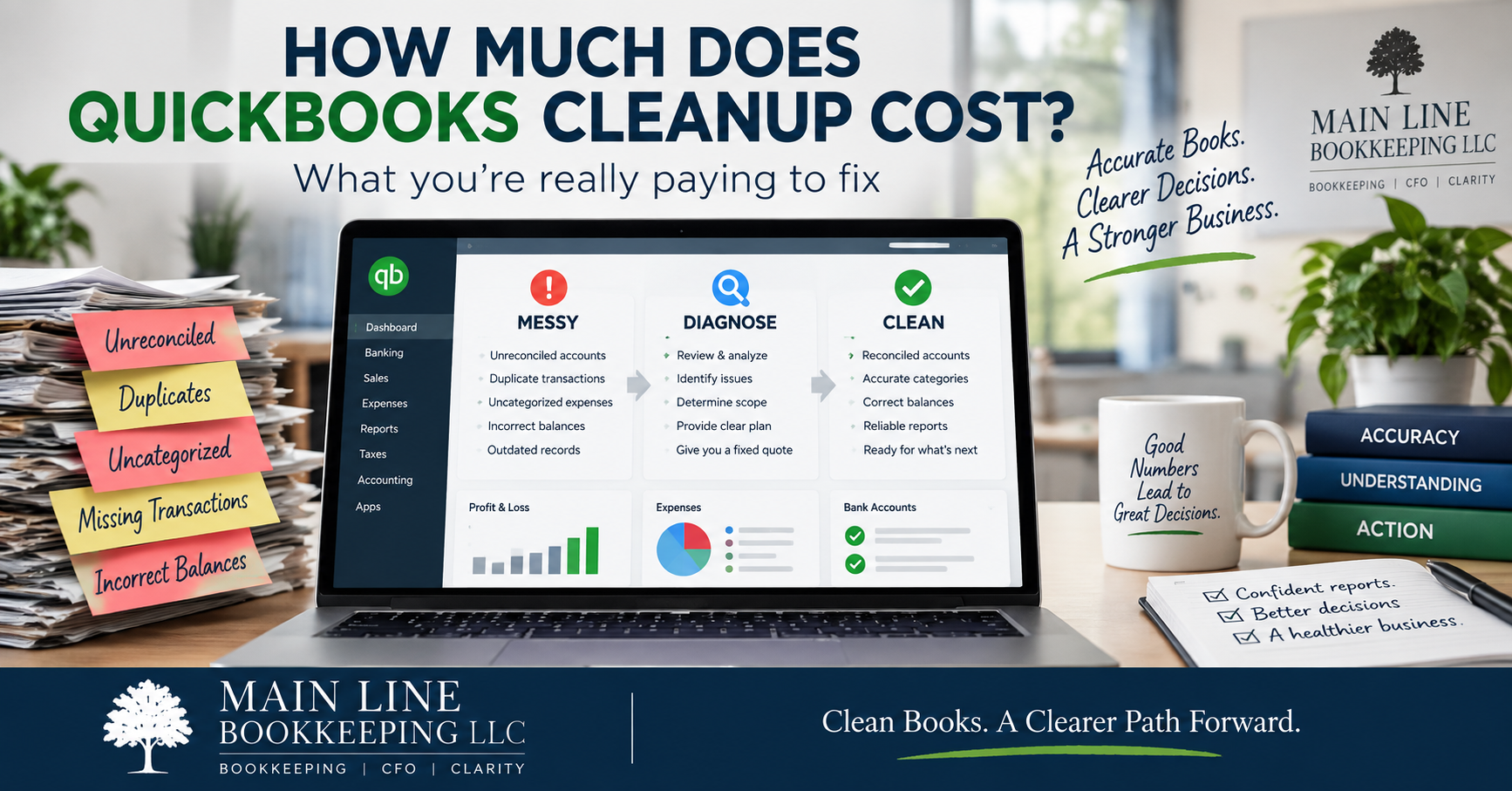
How Much Does QuickBooks Cleanup Cost in 2026?
How Much Does QuickBooks Cleanup Cost in 2026?
Quick answer: QuickBooks cleanup cost can range from several hundred dollars for a relatively minor problem to several thousand dollars for a complicated cleanup or financial reconstruction. For many small businesses, professional cleanup may fall somewhere in the $1,000 to $5,000 range, but the condition and complexity of the books matter much more than simply the number of months involved.
If you’re researching QuickBooks cleanup cost, you’ve probably already discovered that prices can vary considerably. There is a good reason for that.
Before anyone can reasonably tell you what it should cost to clean up your QuickBooks, there is an important question to answer first:
What actually needs to be fixed?
Two businesses can both have “a year of messy books” and require very different amounts of work.
What Is QuickBooks Cleanup and Why Might You Need It?
A QuickBooks cleanup is different from simply entering transactions that have not yet been recorded.
Catch-up bookkeeping generally means bringing books that are behind up to date.
QuickBooks cleanup means identifying and correcting problems in books that may already contain transactions but cannot yet be relied upon for accurate financial reporting.
Sometimes a business needs both.
Common cleanup problems can include:
- Bank or credit card accounts that have not been properly reconciled
- Duplicate transactions
- Transactions posted to incorrect accounts
- Large or unexplained balances sitting in Undeposited Funds
- Old accounts receivable or accounts payable balances
- Incorrect loan or liability balances
- Payroll accounts that do not reconcile
- Uncategorized transactions
- Opening balance problems
- An overly complicated or poorly structured chart of accounts
- Balance Sheet accounts that no longer reflect what the business actually owns or owes
The important distinction is simple:
Being caught up does not necessarily mean your books are correct.
Even QuickBooks offers a dedicated cleanup service, separate from ordinary ongoing bookkeeping. That distinction is important because cleanup is about correcting the accounting foundation before relying on the financial reports it produces.
What Does QuickBooks Cleanup Cost in 2026?
There is no universal QuickBooks cleanup cost because cleanup projects can be dramatically different. Published pricing in the bookkeeping industry commonly ranges from hundreds of dollars for relatively straightforward work to several thousand dollars for extensive or multi-year cleanup projects.
A useful general framework is:
| Type of Cleanup | Illustrative Market Range |
|---|---|
| Minor / focused cleanup | $500–$1,500 |
| Moderate cleanup | $1,500–$3,500 |
| Full-year or more complex cleanup | $2,500–$5,000+ |
| Multi-year or financial reconstruction | $5,000–$10,000+ |
These ranges are general market examples, not Main Line Bookkeeping quotes. An actual cleanup price should be based on the condition and complexity of the individual QuickBooks file.
The biggest reason QuickBooks cleanup cost varies is simple: two files covering the same twelve-month period can require completely different amounts of investigation and correction.
What Determines QuickBooks Cleanup Cost?
The number of months involved matters, but it is only part of the story. Transaction volume alone doesn’t determine QuickBooks cleanup cost, either.
Five factors can have a much greater impact on the amount of work required:
1. Number of Transactions
Twelve months with 50 transactions per month is a very different project from twelve months with 1,500 transactions per month.
2. Number of Accounts
Every bank account, credit card, loan, payment processor and other Balance Sheet account may need to be reviewed and reconciled.
3. Reconciliation History
If the accounts were reconciled correctly through last month, a cleanup may be relatively contained.
If nobody knows when the accounts last reconciled correctly, the investigation may have to go considerably further back.
4. Type of Problems
Categorizing several hundred transactions is one thing.
Correcting years of reconciliation discrepancies, loan balances, payroll liabilities, accounts receivable, accounts payable or improperly recorded assets is another.
5. Quality of the Available Records
Bank statements, credit card statements, loan documents, payroll reports and prior tax returns can make reconstruction considerably easier.
Missing records can make it considerably harder.
Why We Don’t Believe in Guessing at QuickBooks Cleanup Cost
Quoting a cleanup without understanding the condition of the books can create problems for both the business owner and the bookkeeper.
A low quote can become an unpleasant surprise when additional problems are discovered. An overly conservative quote can cause an owner to pay for complexity that does not actually exist.
That’s why determining QuickBooks cleanup cost should begin with understanding what actually needs to be corrected.
We prefer to determine what is wrong first.
Start With a QuickBooks Cleanup Assessment
At Main Line Bookkeeping LLC, a QuickBooks Cleanup Assessment is designed to answer a very specific question:
Can you trust the numbers in your books?
Depending on the circumstances, the review may examine areas such as:
- Bank and credit card reconciliations
- Accounts receivable and accounts payable
- Undeposited Funds
- Payroll and other liability accounts
- Loans and fixed assets
- Unusual or stale Balance Sheet balances
- Duplicate and uncategorized transactions
- Chart of accounts structure
- Profit & Loss and Balance Sheet classifications
The purpose is to identify the issues, determine their significance and establish what would actually be required to correct them.
If you’re trying to determine your QuickBooks cleanup cost, this type of assessment can provide a much more useful starting point than simply estimating a price based on how many months are involved.
QuickBooks Cleanup vs. a Business Financial Health Review
These are related services, but they answer two very different questions.
A QuickBooks Cleanup Assessment asks:
Are the numbers right?
A Business Financial Health Review asks:
What are the numbers telling us about the business?
That distinction matters.
Before analyzing profitability, margins, cash flow or financial trends, we first need reasonable confidence that the underlying accounting information is reliable.
Think of the progression this way:
Accuracy → Understanding → Action
QuickBooks Cleanup: Are the numbers right?
Business Financial Health Review: What do the numbers mean?
CFO Advisory: What should we do about them?
Is QuickBooks Cleanup Worth the Cost?
If your financial reports are being used to make business decisions, prepare tax returns, obtain financing, evaluate profitability or manage cash flow, inaccurate books can become much more expensive than the cleanup itself.
The objective isn’t simply to make QuickBooks look tidy.
The objective is to create financial information you can actually use.
Once the accounting foundation is reliable, monthly bookkeeping and CFO advisory services can help turn those accurate numbers into useful financial information for managing the business.
Not Sure Whether Your Books Need Cleanup?
Your books don’t have to be behind to be wrong.
If balances don’t make sense, accounts won’t reconcile, your CPA keeps finding problems, or you simply don’t trust the financial reports coming out of QuickBooks, the first step doesn’t have to be a major cleanup project.
It can simply be finding out what is wrong.
If QuickBooks cleanup cost is one of the things keeping you from addressing the problem, remember that the size of the cleanup should be determined by the condition of the books—not by guesswork.
Main Line Bookkeeping LLC provides QuickBooks cleanup, monthly bookkeeping and CFO-level financial reporting for businesses throughout the Main Line and surrounding areas.
Start with a QuickBooks Cleanup Assessment and find out whether you can trust your numbers — before you use them to make your next business decision.
Contact Main Line Bookkeeping to discuss your QuickBooks cleanup →