Business Owner Compensation: What Should You Pay Yourself?

PROJECT LIGHTHOUSE | LESSON 013
Your business may be profitable. But is it compensating you fairly for the work you do, the risks you take, and the money you’ve invested?
Business owner compensation is about more than how much money you take home. It’s about understanding what your business pays you for your work, what you earn for accepting ownership risk, and whether the business is building lasting financial value.
In our previous Project Lighthouse lesson, Don’t Start Your 2027 Budget With Last Year’s Numbers, we explored how to establish meaningful financial targets for 2027.
But before we can work backward from those targets, we need to answer a more basic question:
What is your business actually paying you for?
Two Businesses. Same Profit. Very Different Stories.
Imagine two business owners.
Both operate businesses reporting $180,000 in annual profit.
Owner A works 60 hours a week. He manages customers, supervises employees, handles scheduling, makes purchasing decisions, and personally solves nearly every problem that comes through the door.
Owner B works 25 hours a week. She has capable employees, established systems, and managers who handle most day-to-day operations. She can leave for two weeks without the business grinding to a halt.
On paper, both businesses earn $180,000.
But are they equally successful?
No.
And understanding why can completely change how you evaluate your business.
Your Business Pays You for Two Different Things
Most small business owners wear two hats.
The First Is Employee
You perform work that somebody else would have to do if you weren’t there. You manage projects, sell services, supervise people, prepare estimates, or handle operations.
That work has a market value.
The Second Is Owner
You’ve invested capital, accepted financial risk, signed guarantees, and taken responsibility for the success or failure of the business.
Ownership should generate a return beyond the value of your labor. Otherwise, you’re accepting the responsibilities and risks of ownership without being adequately rewarded for them.
Those are two different economic functions, even when the money ultimately lands in the same bank account.

When we combine them into one profit number, we lose sight of what the business is actually producing.
The $180,000 Reality Check
Let’s return to our two business owners.
Suppose Owner A would need to hire management personnel costing at least $125,000 annually, including payroll taxes and benefits, to replace the work he currently performs.
Given his 60-hour workweek and range of responsibilities, that could be a conservative estimate.
Owner B would need only $50,000 in additional management and oversight costs to replace her remaining responsibilities.
| Financial Measure | Owner A | Owner B |
|---|---|---|
| Reported annual profit | $180,000 | $180,000 |
| Replacement labor cost | ($125,000) | ($50,000) |
| Labor-adjusted profit | $55,000 | $130,000 |
| Owner hours per week | 60 | 25 |
| Profit per owner hour | $58 | $138 |
Illustrative figures assume reported profit excludes compensation for the owners’ labor. Replacement costs are hypothetical economic adjustments, not additional tax deductions.
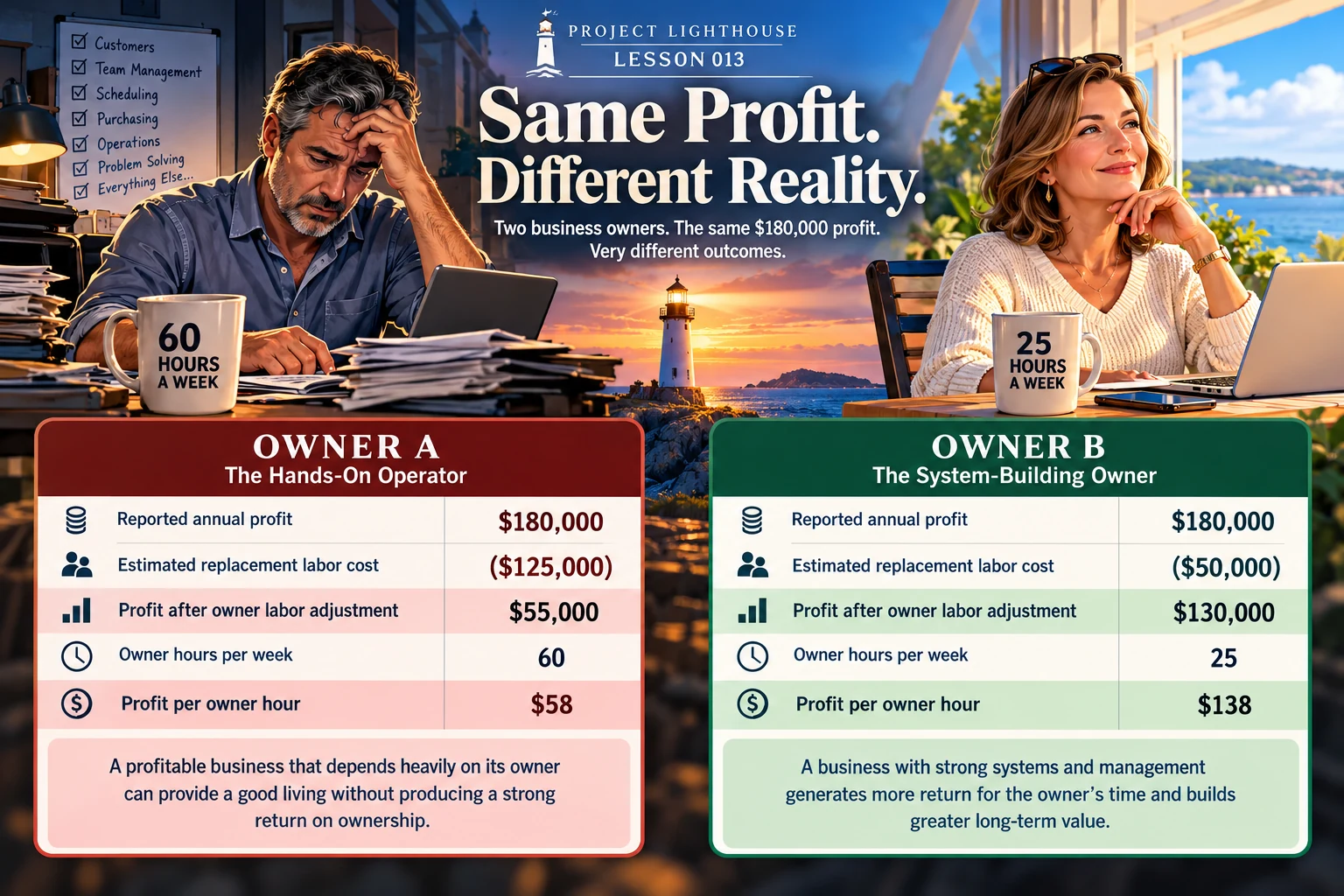
Both businesses report the same $180,000. But Owner A’s business produces only $55,000 after recognizing the economic value of the owner’s work. Owner B’s business produces $130,000.
That’s a $75,000 difference in economic profit.
Owner A generates approximately $58 in reported profit for every hour worked. Owner B generates approximately $138.
These aren’t hourly wages. They represent reported profit divided by the owner’s working hours, before separating compensation for labor from return on ownership.
CFO INSIGHT
Profit Isn’t Always the Same as Return on Ownership
A business that depends heavily on its owner can provide a comfortable living without producing a particularly strong return on ownership.
That doesn’t make it a bad business. But it changes how we evaluate its profitability, growth opportunities, and long-term value.
And what happens when it’s time to sell?
Buyers generally value businesses based on earnings they can reasonably expect to continue after the current owner leaves.
All else being equal, Owner B’s business could command both a higher valuation multiple and a higher earnings base because more of its profitability survives the owner’s departure.
That’s not just an income difference. It’s a potential wealth difference.
Your Salary, Your Draw, and Your Profit Are Not the Same Thing
Owners often use the terms salary, draw, distribution, and profit interchangeably. But they aren’t interchangeable.
Salary or wages compensate someone for performing work. When an owner is legally treated as an employee, those wages generally appear as an expense on the company’s financial statements.
Owner draws are withdrawals of equity by owners of businesses such as sole proprietorships. They generally do not reduce business profit.
Distributions transfer money or property from a business to its owners. Their tax treatment depends on the business structure and the owner’s circumstances.
Guaranteed payments are payments partnerships, including many multi-member LLCs taxed as partnerships, make to partners for services or capital without regard to partnership income. They generally aren’t employee wages.
Profit is the amount remaining after recognized revenues and expenses under the company’s accounting method.
For an S corporation, a shareholder who performs substantial services generally must receive reasonable compensation as wages before taking nonwage distributions.
For a sole proprietor, owner draws aren’t deductible salary expenses. LLC tax treatment depends on the entity’s classification and elections.
For more information, see the
IRS guidance on S corporation compensation.
How you withdraw money from your business isn’t necessarily the same as how much your business earns—or how much your work is worth.
Business Owner Compensation: What Should Your Business Actually Pay You?
A sound business owner compensation strategy isn’t based on a single percentage of revenue or profit. Start with five questions.
1. What Would It Cost to Replace You?
List your responsibilities and estimate what qualified employees or outside professionals would cost to handle them.
Include wages, employer payroll taxes, benefits, and other necessary employment costs.
This gives you a benchmark for the economic value of your labor. It isn’t automatically the amount you should run through payroll.
2. How Much Cash Can the Business Sustainably Provide?
A profitable business can still have cash-flow problems.
Accounts receivable, inventory purchases, loan payments, taxes, and seasonal fluctuations can consume cash that appears available on the income statement.
Before increasing owner withdrawals, examine your cash flow and upcoming obligations.
3. What Does the Business Need to Retain?
Your company needs money for equipment, hiring, technology, working capital, and future growth.
Taking every available dollar out of the business leaves it financially vulnerable.
But retaining every dollar without a clear purpose isn’t necessarily a good strategy either.
The objective is to balance the financial needs of the business with the financial needs of its owner.
4. What Return Are You Earning for Taking Ownership Risk?
Return to Owner A. After accounting for the estimated cost of replacing his labor, the business produces $55,000 in economic profit.
Now suppose he has $400,000 of capital and personal financial exposure tied to the business.
ILLUSTRATIVE RETURN RELATIVE TO EXPOSURE
$55,000 ÷ $400,000 = 13.75%
A starting point for evaluating risk and reward
Is that enough?
That depends on the business’s risk, the nature of the owner’s investment and guarantees, and the alternatives available for that money.
A 14% return from a stable, well-managed business is very different from a 14% return from a business with unpredictable cash flow, concentrated customers, significant debt, and constant demands on the owner.
Personal guarantees create financial exposure, but their face value isn’t automatically equivalent to invested equity.
This is a starting point for evaluating risk and reward, not a formal investment return calculation.
Are you being adequately compensated for both your work and the financial risk you’re accepting?
5. Is Your Compensation Aligned With Your Long-Term Goals?
Do you want to work fewer hours? Build a management team? Increase retirement savings? Eventually sell the company?
Your compensation strategy should support the life and business you’re trying to build—not merely reflect whatever cash happens to be available at the end of the month.
A Practical Owner Compensation Exercise
Take your most recent twelve months of financial results and answer these questions.
- What is your business’s annual profit?
- What would it cost to replace your work?
- What profit remains after adjusting for your labor?
- How much cash did you actually receive from the business?
- How many hours do you work each week?
- What is your reported profit per owner hour?
- How much capital do you have invested?
- What additional personal financial exposure do you carry?
- How much cash must remain in the business?
A word of caution: When calculating adjusted profit, don’t subtract owner wages already included in your reported expenses a second time. Your starting profit and replacement-cost assumptions need to be consistent.
The answers won’t automatically tell you what salary or distribution to take.
But they’ll give you a clearer picture of whether the business is compensating you for your work, generating a meaningful return on ownership, and supporting your financial goals.
Are You Building a Business—or Creating a Job?
There’s nothing wrong with owning a business that provides a good living.
For many entrepreneurs, that’s a tremendous accomplishment.
But there’s an important difference between owning a business that generates income because you work there and owning a business that can generate income without depending entirely on your daily involvement.
The first provides income. The second creates the opportunity for income, financial independence, and transferable business value.

The goal isn’t necessarily to stop working. It’s to create a business where the amount you work becomes a choice rather than an absolute requirement.
THE BOTTOM LINE
If your business reports $180,000 in profit, that’s a number worth celebrating. But effective business owner compensation requires looking beyond that single number.
How much of that $180,000 is compensation for the work you perform—and how much is the return you’re earning for owning the business?
The answer tells you far more about the financial strength of your company than the profit number alone.
NEXT IN PROJECT LIGHTHOUSE
How Much Revenue Does Your Business Really Need?
Now that we’ve separated compensation for your work from the return on ownership, we can deliver on the question we introduced in Lesson 012.
We’ll work backward from your desired owner compensation, operating expenses, profit targets, and cash requirements to determine what your business needs to produce.
No arbitrary growth percentages. No wishful thinking. Just a revenue target built around your actual financial goals.
Want to Know How Your Business Measures Up?
Your profit and loss statement tells you what your business earned. But does it tell you whether your business is building the financial future you want?
Take the next step toward identifying the numbers, risks, and opportunities that deserve your attention.
This lesson is provided for educational purposes and isn’t tax, legal, or investment advice. Consult your tax advisor about compensation requirements and tax treatment for your business entity.
One Comment
Comments are closed.