Should I Hire a Bookkeeper or Use QuickBooks Alone?
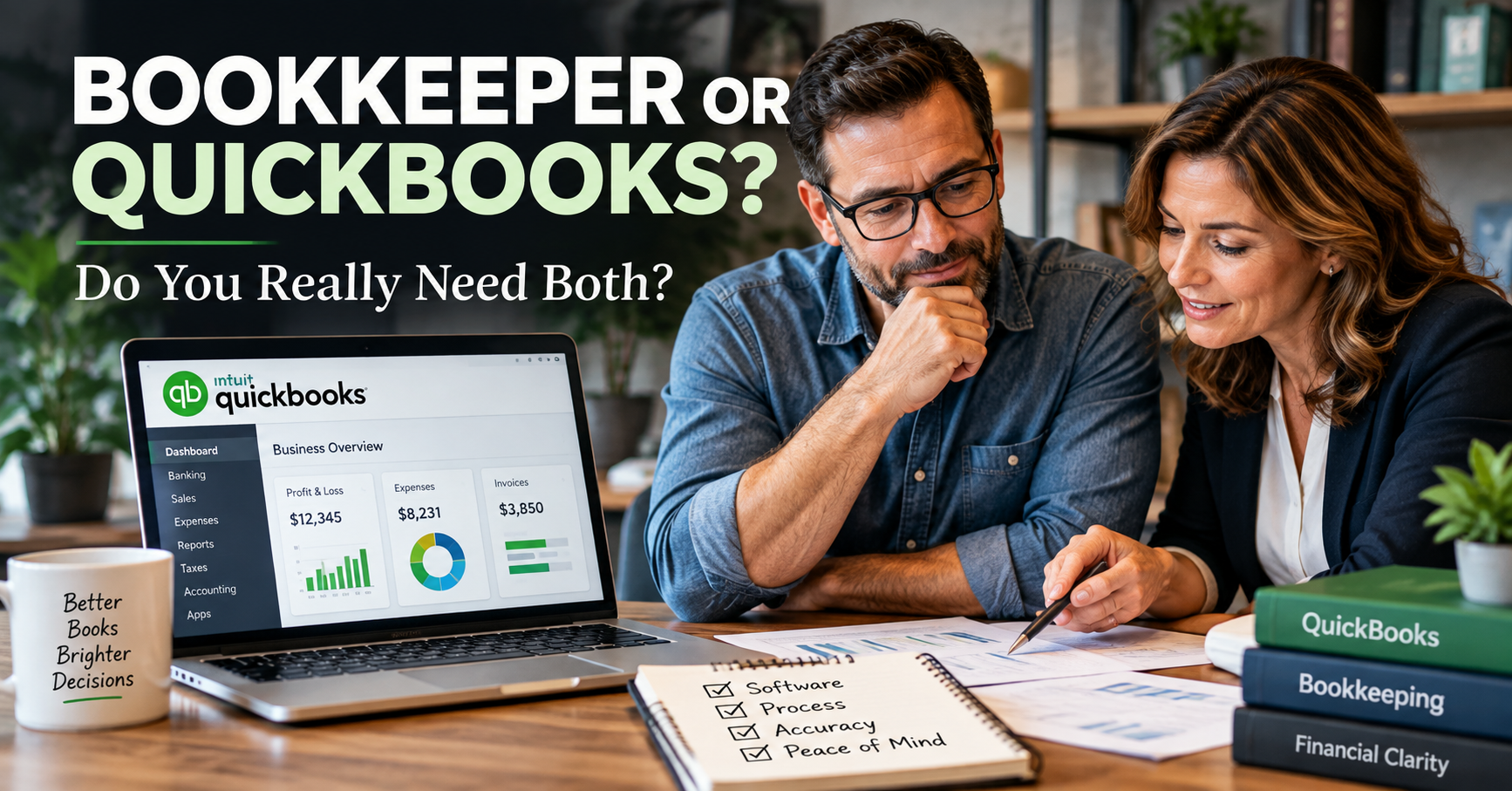
Quick answer: If you’re deciding between a bookkeeper or QuickBooks alone, remember that QuickBooks is a tool; a bookkeeper makes sure it’s used correctly. A simple business with an owner who knows basic bookkeeping can often manage alone. As payroll, loans, job costing, or inventory get added, the real question becomes whether you have the time and knowledge to keep it right.
What QuickBooks Can Do Very Well
QuickBooks can handle a tremendous amount of the mechanical work involved in bookkeeping.
Depending on your setup, it can help you:
- Connect bank and credit-card accounts
- Import transactions
- Categorize income and expenses
- Create invoices and record payments
- Track bills and vendors
- Run financial reports
- Track customers and projects
- Connect with payroll and other business systems
QuickBooks offers a wide range of features for handling the day-to-day mechanics of accounting. You can see Intuit’s current QuickBooks Online features and options here.
Automation makes all of that faster.
But there’s an important distinction:
QuickBooks can process the information you give it. It doesn’t necessarily know whether that information is right.
What QuickBooks Doesn’t Decide for You
Suppose $10,000 enters your bank account.
QuickBooks can see the deposit.
But what is the $10,000?
Is it:
- Customer revenue?
- A customer deposit for work you haven’t performed yet?
- Loan proceeds?
- Money contributed by an owner?
- A transfer from another company account?
- Payment of an invoice already recorded in QuickBooks?
Those transactions can look remarkably similar when they hit the bank.
They don’t necessarily belong in the same place in your books.
Record an invoice payment as new income when the sale is already recorded in QuickBooks, and you can end up counting the same sale twice.
That’s where bookkeeping knowledge matters.
When QuickBooks Alone May Be Enough
When deciding between a bookkeeper or QuickBooks on your own, doing the bookkeeping yourself can make perfectly good sense when:
- Your business has relatively few transactions
- You have only a small number of bank and credit-card accounts
- You understand basic bookkeeping
- You consistently reconcile your accounts
- Your payroll and tax situation is straightforward
- You know how to review your Profit & Loss Statement and Balance Sheet
- You have the time to keep everything current
- You know when something looks wrong
There’s nothing inherently wrong with DIY bookkeeping.
In fact, an owner who understands the books can learn an enormous amount about the business.
The problem starts when doing the books becomes something you squeeze in late at night, put off for three months, or rush through without really knowing whether the result is correct.
Signs You May Be Outgrowing DIY QuickBooks
You may want bookkeeping help when you start seeing things like:
- Bank or credit-card accounts that haven’t been reconciled
- Duplicate or unexplained transactions
- Growing Uncategorized or Ask My Accountant balances
- Old receivables that don’t make sense
- Customer deposits recorded as income without knowing whether they should be
- Loan payments recorded entirely as expenses
- Transfers showing up as income or expenses
- Payroll liability accounts that don’t reconcile
- Sales tax balances that don’t match your filings
- Profit numbers that don’t seem to match what’s happening in the business
- Reports you don’t understand or don’t trust
- Several months of bookkeeping waiting to be done
There’s another warning sign that’s even simpler:
You know the bookkeeping needs to be done, but you no longer have the time to do it properly.
What Does a Bookkeeper Add?
A good bookkeeper isn’t there merely to push buttons in QuickBooks.
The value is in the process around the software.
That can include:
- Reviewing and properly categorizing transactions
- Reconciling bank and credit-card accounts against actual statements
- Investigating discrepancies
- Maintaining the chart of accounts
- Handling loans, fixed assets, deposits, and other transactions correctly
- Reviewing accounts receivable and accounts payable
- Closing the books consistently each month
- Producing reliable financial statements
- Identifying unusual balances or transactions that need attention
The goal isn’t simply to have QuickBooks filled in.
The goal is to have financial information you can actually use.
Bookkeeper or QuickBooks Isn’t Really an Either/Or Question
This is where the question gets turned around a little.
For many growing businesses, the choice isn’t:
QuickBooks OR a bookkeeper.
It’s:
QuickBooks WITH a bookkeeper.
QuickBooks provides the accounting system. The bookkeeper provides the process, review, and judgment needed to keep that system useful.
Think of it this way:
Buying QuickBooks doesn’t automatically give you good books any more than buying a toolbox automatically makes you a carpenter.
The software matters.
So does knowing how to use it.
What If I Enjoy Doing My Own Books?
Then you don’t necessarily need to stop.
You might instead have a professional periodically review your QuickBooks setup, reconciliations, chart of accounts, and financial statements.
That can provide another set of eyes while allowing you to continue handling the day-to-day bookkeeping yourself.
The right amount of help isn’t the same for every business.
Choosing between a bookkeeper or QuickBooks alone doesn’t have to be permanent. As your business changes, the amount of bookkeeping help you need can change too.
Not Sure How Much Bookkeeping Help You Need?
If you’re wondering whether your current bookkeeping process is keeping up with your business, start with our Business Financial Health Assessment.
It’s a quick way to look at where your bookkeeping and financial systems stand today—and where there may be gaps.
Take the Business Financial Health Assessment →
Decided It’s Time to Talk to a Bookkeeper?
Don’t hire the first person who knows how to log into QuickBooks.
We put together another Answer Desk guide covering the practical questions worth asking before you turn over your books.
What Questions Should I Ask Before Hiring a Bookkeeper? →
Want to Go Deeper?
If the real issue isn’t whether you’re doing the bookkeeping yourself—but whether you can trust the numbers currently coming out of QuickBooks—that’s a different question.
We explore that in more detail in Project Lighthouse.
Can I Trust My QuickBooks Numbers? →
It walks through warning signs that your financial information may need a closer look and what those warning signs may be telling you.
Still Have a Question?
Main Line Bookkeeping works with businesses that need everything from QuickBooks cleanup and monthly bookkeeping to CFO-level financial guidance.
Sometimes the answer is that you need ongoing help. Sometimes you just need the system straightened out. And sometimes you’re perfectly capable of doing it yourself.
The goal is figuring out which one actually fits your business.