Can My Business Afford to Grow? When More Revenue Creates a Cash Shortage

Can my business afford to grow? It's a question worth asking before accepting more projects, hiring additional employees, or investing in equipment.
Growing revenue can improve profitability. But additional work often requires additional cash before customers pay their invoices. Materials must be purchased, crews must be paid, and suppliers expect payment whether or not the customer has settled the bill.
In our last lesson, we calculated how much revenue a construction and landscaping contractor needed to meet its owner's financial goals. Now we'll examine what pursuing that higher target could do to the company's cash.
Because a business can afford the work on paper and still struggle to finance it in practice.
Can My Business Afford to Grow? Start With the Revenue Target
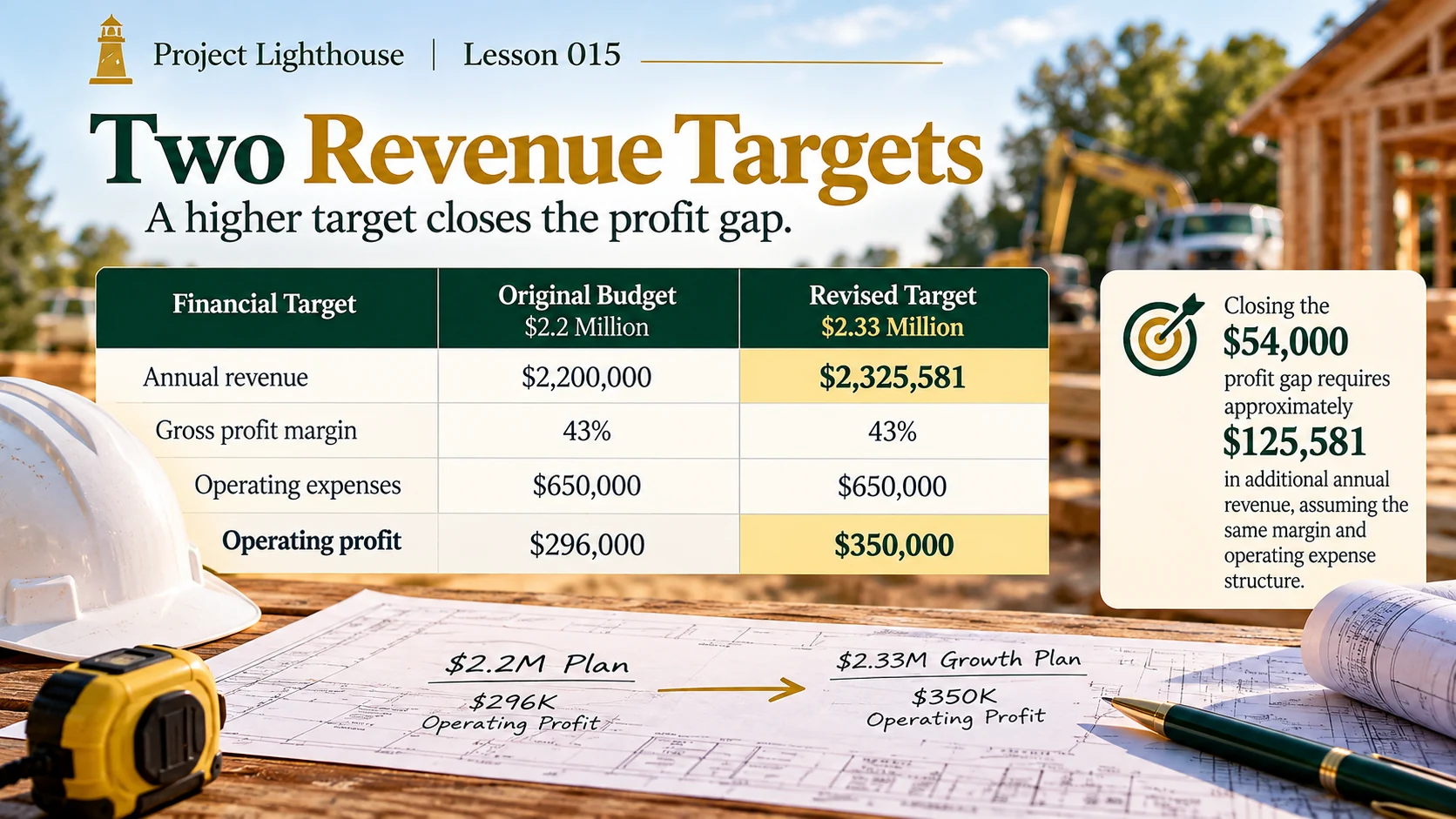
In Lesson 014: How Much Revenue Does My Business Need?, our contractor discovered that its original $2.2 million revenue budget wasn’t sufficient to meet the owner’s financial goals.
At a 43% gross profit margin, the original plan generated $296,000 in operating profit. The owner needed $350,000.
Closing that $54,000 profit gap required approximately $125,581 in additional annual revenue, assuming the same margin and operating expense structure.
| Financial Target | Original Budget | Revised Target |
|---|---|---|
| Annual revenue | $2,200,000 | $2,325,581 |
| Gross profit margin | 43% | 43% |
| Operating expenses | $650,000 | $650,000 |
| Operating profit | $296,000 | $350,000 |
The revised target makes financial sense under those assumptions.
But generating more revenue may require the contractor to commit additional cash before the related customer payments arrive.
That's the next problem we need to solve.
The Job Is Profitable. The Cash Hasn't Arrived.
Picture the owner reviewing the spring project schedule.
The company has secured additional work. That's good news. But before the crews can begin, materials must be ordered, subcontractors scheduled, and payroll funded.
The owner knows the expected profit on those projects.
What isn't immediately obvious is how much additional cash the business must advance while waiting for customer payments.
This is called a working-capital requirement.
To answer the question, “Can my business afford to grow?” the owner must understand not only expected profitability but also the cash required before customers pay.
Working capital generally refers to current assets minus current liabilities. In practical terms, a growing contractor must pay close attention to how much cash becomes tied up in receivables, materials, and other operating needs—and how much of that requirement is temporarily financed by suppliers or customer deposits.
Let's see what happens when the company takes on more work.
Two Revenue Plans. Two Different Cash Outcomes.

We'll compare the contractor's original $2.2 million budget with the revised $2.33 million growth target.
These are illustrative cash forecasts, not historical results. The growth scenario assumes the company pays an additional $25,000 during February and March for work associated with the higher revenue target, while the related additional customer collections arrive after March.
Both scenarios begin with the same $175,000 cash balance.
| Cash Forecast | January | February | March |
|---|---|---|---|
| Original $2.2M Plan | |||
| Beginning cash | $175,000 | $165,000 | $150,000 |
| Cash receipts | $145,000 | $150,000 | $165,000 |
| Cash payments | ($155,000) | ($165,000) | ($170,000) |
| Ending cash | $165,000 | $150,000 | $145,000 |
| Revised $2.33M Growth Plan | |||
| Beginning cash | $175,000 | $165,000 | $140,000 |
| Cash receipts | $145,000 | $150,000 | $165,000 |
| Cash payments | ($155,000) | ($175,000) | ($185,000) |
| Ending cash | $165,000 | $140,000 | $120,000 |
Notice the difference.
Under the original budget, the contractor finishes March with $145,000.
Under the growth plan, it finishes with $120,000.
The additional work has temporarily consumed $25,000 more cash before producing additional collections.
The growth hasn't necessarily reduced the company's profitability. In fact, the added projects are intended to increase annual operating profit.
But they have increased its immediate need for cash.
That is the difference between having a profitable growth opportunity and having the liquidity to pursue it.
Why Growth Ties Up Cash
Here's another way to understand the problem.
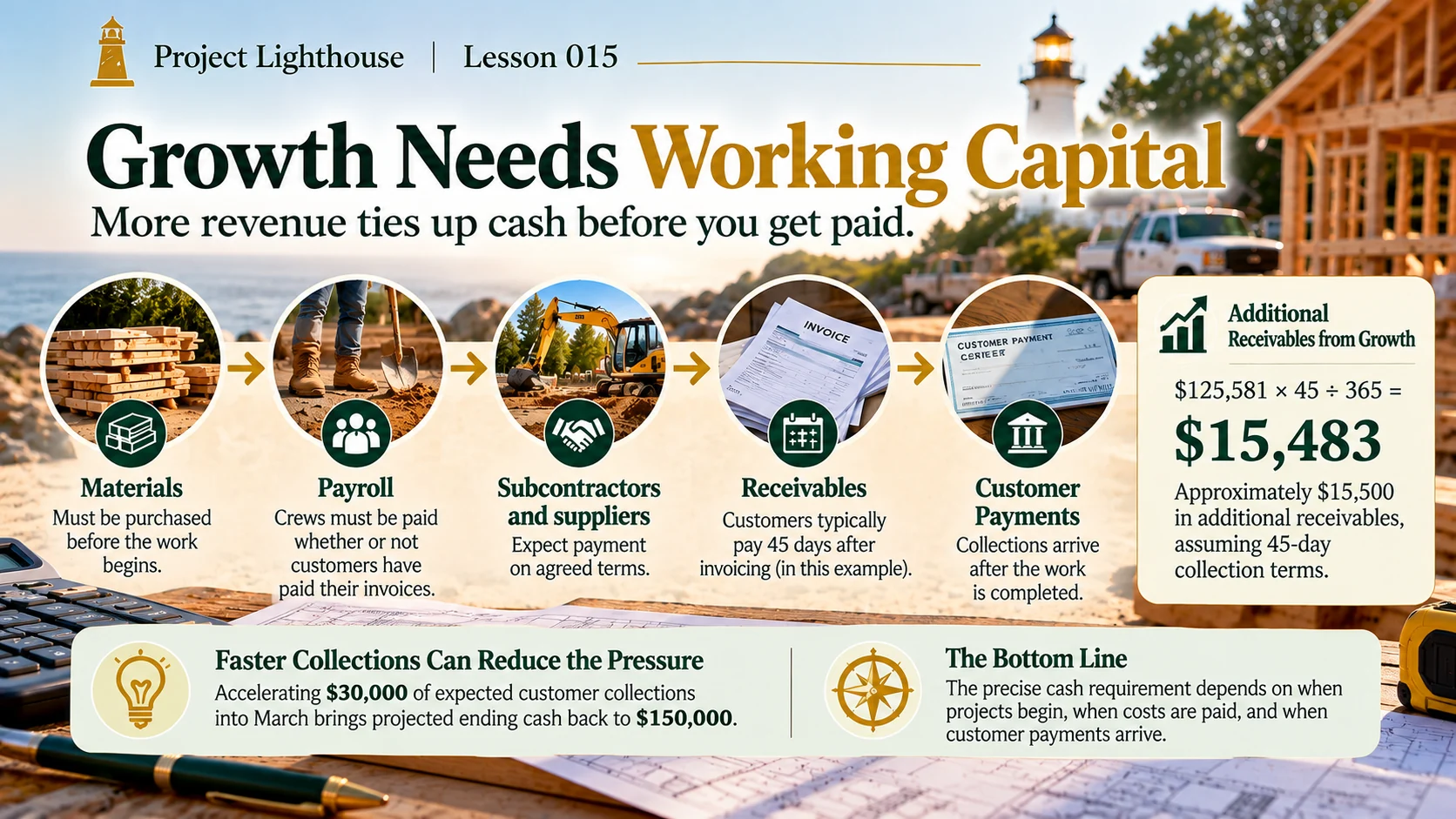
Suppose the contractor generally waits 45 days to collect customer invoices.
At the revised revenue target, the business expects approximately $125,581 more annual revenue than under the original budget.
If that additional revenue is earned evenly throughout the year and collection timing remains unchanged, the approximate additional accounts receivable associated with the growth is:
$125,581 × 45 ÷ 365 = $15,483
That's roughly $15,500 in additional receivables the business may need to finance.
And receivables are only part of the story.
The contractor may also need to purchase materials, fund payroll, or pay subcontractors before customers pay. Customer deposits and supplier payment terms can offset some of those requirements.
The $15,500 calculation is a simplified estimate of the additional receivables associated with growth. It is not an amount to add automatically to the $25,000 forecast difference; both calculations illustrate aspects of the same underlying cash-timing problem.
The precise cash requirement depends on when projects begin, when costs are paid, and when customers actually pay.
More revenue doesn't automatically create more available cash. Sometimes it creates a greater need for cash first.
What Happens to the Cash Reserve?
When asking “Can my business afford to grow?” the minimum cash balance matters as much as the projected operating profit.
In Lesson 014, our owner included a $40,000 annual contribution toward building cash reserves.
For this example, assume management has separately established a minimum operating cash balance of $150,000.
That's a planning target for the cash the business wants to maintain—not an expense and not the same thing as the annual reserve contribution.
Now compare the two forecasts.
| Month | Original Plan | Growth Plan | Minimum Cash Target |
|---|---|---|---|
| January | $165,000 | $165,000 | $150,000 |
| February | $150,000 | $140,000 | $150,000 |
| March | $145,000 | $120,000 | $150,000 |
Under the original plan, March cash is $5,000 below the reserve target.
Under the growth plan, March cash is $30,000 below it.
The growth plan therefore creates an additional $25,000 shortfall relative to the original plan.
The company hasn't run out of money. But it has less financial flexibility than management intended.
And here's another consideration: these figures show month-end balances.
The actual low point could occur in the middle of a month, perhaps after payroll and supplier payments but before a large customer deposit arrives.
That's why a rolling 13-week cash-flow forecast can reveal problems that monthly financial statements and month-end balances miss.
Four Ways to Reduce the Cash Pressure
1. Improve customer deposits and progress billing
Review whether customer deposits adequately cover the initial cash required to begin projects.
Where contracts and customer relationships permit, consider progress billing tied to meaningful project milestones. The goal is to reduce the amount of work the company must finance before receiving payment.
2. Collect outstanding invoices sooner
Suppose the contractor can legitimately accelerate $30,000 in expected customer collections into March.
Under the growth forecast, March receipts increase from $165,000 to $195,000.
With beginning cash of $140,000 and payments of $185,000, the company ends March with $150,000—meeting its minimum cash target.
That doesn't create additional revenue or profit. It changes when the company receives money it has already earned.
The later forecast must also be reduced by that $30,000 so the same collections aren't counted twice.
3. Coordinate supplier payments with project cash receipts
The owner may be able to negotiate appropriate payment terms, coordinate material deliveries with project schedules, or avoid purchasing supplies substantially earlier than necessary.
The objective isn't to delay legitimate obligations beyond their agreed terms. It's to manage the timing of purchases and payments intelligently.
4. Arrange financing before the cash is needed
A properly structured working-capital line of credit may help bridge temporary gaps between project expenditures and customer collections.
Business owners evaluating financing can review the U.S. Small Business Administration’s loan programs as a starting point for understanding available options.
But borrowing introduces costs and repayment obligations. It should support a credible cash-conversion plan, not disguise unprofitable work or permanently inadequate cash generation.
A line of credit is worth evaluating before the business faces an urgent shortage, when management has more time to compare options.
From the CFO's Desk: The Revenue Target Isn't the Whole Plan
Our contractor has done something important: it calculated the revenue required to support the owner's financial goals instead of simply choosing a sales target.
But a revenue goal is only one part of the financial plan.
Management must also understand the cash required to achieve that goal.
That means examining expected collections, project spending, payroll, supplier terms, customer deposits, debt obligations, and the lowest projected cash balance.
The decision isn't necessarily to abandon growth because it creates a temporary cash shortage.
It's to determine how the business will finance that growth without jeopardizing its existing obligations.
A financially attractive opportunity can become a problem if the company commits to it without sufficient working capital.
The Lighthouse Principle
A revenue target tells you what the business needs to earn. A cash-flow plan tells you whether the business can afford to earn it.
Growth can improve profitability, strengthen the company, and create new opportunities.
But the owner needs to understand the cash requirements before committing to additional work.
The objective is not simply more revenue.
It's profitable, financially sustainable growth.
Put It Into Practice: Build Your 13-Week Cash Forecast
Start with the cash you have available today.
Then forecast expected customer receipts and required payments for each of the next 13 weeks. Include payroll, suppliers, taxes, debt payments, equipment purchases, and other significant cash commitments.
If you're planning additional revenue, create a second scenario that reflects the timing of the extra project costs and customer collections.
Compare the two forecasts.
Where does the cash balance reach its lowest point? Does it fall below the reserve you want to maintain? What could management change before that happens?
A rolling forecast won't eliminate uncertainty. It gives you time to respond to it.
The Bottom Line
Can my business afford to grow? The answer depends on more than the revenue target. It depends on whether the company can finance the additional work while maintaining sufficient operating cash.
Our contractor's revised revenue target offers the prospect of higher annual profit.
But in our illustrative first-quarter forecast, pursuing that additional work requires $25,000 more cash before the corresponding customer collections arrive.
That difference pushes the projected March balance from $145,000 under the original plan to $120,000 under the growth plan.
The business doesn't necessarily need less work.
It needs a plan for financing the work it wants to take on.
Take the Next Step
Put your cash-flow plan on paper.
Explore our 13-Week Cash Flow Forecast to see how a rolling forecast can help you anticipate cash shortages before they become emergencies.
If you’re unsure whether your financial records are reliable enough for planning, start with our free Business Financial Health Assessment.
And if you're wondering why a profitable business can still experience cash shortages, revisit Your Business Is Profitable. So Why Is There No Cash?.
Coming Next in Project Lighthouse: Your Business Can Afford the Payment. But Can It Afford the Debt?
We've examined how growth can increase the need for cash before it increases cash receipts.
Next, we'll look at another important financial commitment: borrowing.
We'll explain debt-service coverage in plain English and show how a business owner can evaluate whether additional financing makes sense—not just whether the monthly payment looks affordable.