When Is Your Business Ready for a Fractional CFO?
Your business may be ready for a fractional CFO when the financial decisions you’re making have become more complicated than the reports you’re using to make them.
You don’t need a magic revenue threshold, dozens of employees, or a full-time finance department. You need reliable financial information, meaningful decisions to make, and guidance that helps you understand what the numbers mean for your next move.
A fractional CFO provides senior-level financial guidance on a part-time or contracted basis. Here are five signs that support might be worth exploring.
5 Signs Your Business May Be Ready for a Fractional CFO
1. Your Business Is Profitable, but Cash Is Still Tight
Your profit and loss statement shows a profit. Your bank balance tells a different story. Customers may be paying slowly, loan payments may be consuming cash, or payroll may arrive before receivables do.
A forward-looking cash flow forecast can show when shortages may arise and which payments or decisions deserve attention. Our 13-week cash flow forecasting lesson explains why looking ahead matters.
2. Revenue Is Growing, but You Can’t Explain Your Margins
Sales are up, everyone is busier, yet profit isn’t keeping pace. In construction, landscaping, and service businesses, changes in labor, materials, subcontractor costs, and pricing can quietly erode margins.
Instead of looking only at total revenue, financial advisory work examines which jobs and services contribute to profit, where costs are rising, and whether growth is improving the business.
3. You’re Making Expensive Decisions Without Financial Projections
Should you hire another employee, buy a truck, or expand into a new service? Having cash in the bank today doesn’t necessarily mean a decision will pay for itself.
Example: Can a $60,000 truck justify its cost?
Suppose the truck creates a $1,200 monthly loan payment, $250 in additional insurance, and a $200 monthly maintenance reserve. That’s $1,650 per month in modeled cash requirements.
If additional work produces a 40% contribution margin, the truck would need approximately $4,125 in additional monthly revenue to cover those modeled costs ($1,650 ÷ 0.40).
Illustrative figures, not a financing quote or full break-even analysis. Fuel, labor, taxes, down payment, other costs, and eventual resale value may change the decision. Loan principal is a cash outflow, not a profit-and-loss expense.
The point is to test the decision before committing—not simply assume a new asset will create enough work to support itself.
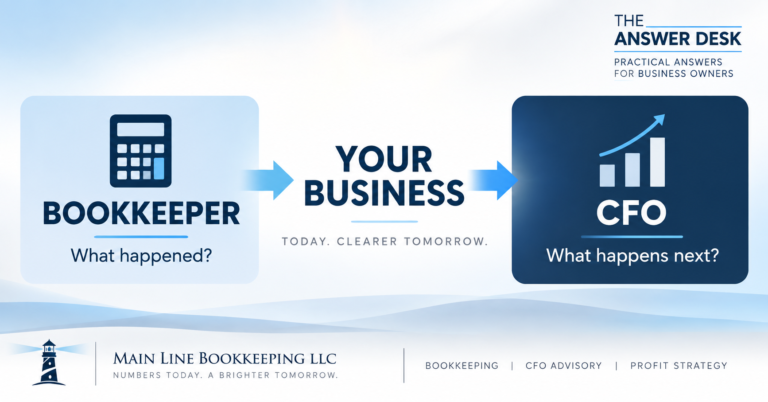
4. Your Reports Tell You What Happened, but Not What to Do Next
Monthly statements are useful, but they can’t make decisions for you. If you struggle to explain a margin decline, assess hiring capacity, or plan next quarter’s spending, you may need forecasting and management analysis alongside bookkeeping.
Our Project Lighthouse lesson, How Much Revenue Does My Business Need?, shows how to work backward from financial goals rather than guessing at a sales target.
5. You’re Spending Too Much Time Acting as Your Own Financial Department
Many owners become the unofficial CFO. They manage pricing, financing, cash, purchasing, and hiring without a repeatable financial planning process. A fractional CFO can bring structure and perspective while leaving the final business decisions with the owner.
Bookkeeper, Controller, or Fractional CFO?
| Role | Primary focus |
|---|---|
| Bookkeeper | Records transactions, reconciles accounts, and maintains accurate books. |
| Controller | Oversees accounting processes, financial controls, reporting, and the monthly close. |
| Fractional CFO | Guides financial planning, cash management, profitability analysis, and major decisions. |
Responsibilities can overlap, especially in smaller companies. Read our bookkeeper-versus-CFO guide for a closer comparison.
When Is a Business Not Ready for Fractional CFO Services?
Sometimes the first step is better bookkeeping. If accounts haven’t been reconciled, transactions are missing, or financial statements can’t be trusted, forecasts built on those numbers may be misleading.
Establish a dependable monthly close, clear reporting, and accurate cash balances first. Strategic guidance becomes more useful when the underlying financial information is sound.
The 60-Second Fractional CFO Readiness Test
Ask yourself:
- Can I reasonably forecast my cash position 30, 60, and 90 days ahead?
- Do I know which services or jobs generate the strongest margins?
- Can I evaluate a major purchase or hire with a financial projection?
- Do monthly reports help me make decisions, rather than just review history?
- Do I have the time and expertise to plan the next stage of my business?
If you answered no to two or more, it may be worth exploring more structured financial planning. This is a conversation starter, not a validated diagnostic or automatic reason to hire a CFO.
Want a More Complete Picture of Your Financial Health?
Your answers are a starting point. Our free Business Financial Health Assessment takes a closer look at your bookkeeping, reporting, cash flow, and financial decision-making practices, helping identify practical next steps.
How Are Fractional CFO Engagements Structured?
Support may include periodic advisory meetings, rolling cash flow forecasts, budgets, margin reviews, or ongoing decision support. Some businesses need help with a specific decision; others benefit from monthly guidance.
The scope and fee depend on complexity, deliverables, and involvement. Before engaging anyone, agree on the questions to be answered, the reports to be delivered, the meeting cadence, and the cost. Evaluate the potential value against the actual fee rather than assuming guaranteed savings or returns.
Frequently Asked Questions
How many hours per month does a fractional CFO work?
There is no universal number. A focused advisory engagement may involve a few hours of analysis and meetings, while complex forecasting, financing, or operational decisions may require substantially more. The scope should determine the time commitment.
Can my bookkeeper also be my CFO?
Possibly. Some professionals offer both bookkeeping and strategic financial advisory services. What matters is whether they have the experience and capacity to provide reliable accounting information, useful analysis, and sound decision support—not simply their job title.
What happens in the first month of a fractional CFO engagement?
Typically, the advisor reviews existing financial statements and reporting processes, identifies pressing cash flow or profitability questions, and agrees on priorities, deliverables, and a meeting rhythm. If the books need cleanup, that may come first.
The Bottom Line
Your business doesn’t have to reach a particular revenue milestone before considering a fractional CFO. It needs decisions important enough to justify more structured analysis and guidance—and a reliable financial foundation to support that work.
Main Line Bookkeeping LLC works with business owners in the Main Line and greater Philadelphia area, including Chester and Montgomery Counties, as well as businesses served remotely. We help owners connect accurate bookkeeping with practical financial understanding and forward-looking decisions.
If you’re ready to discuss your business’s financial questions, contact Main Line Bookkeeping. Or begin with the free Business Financial Health Assessment.