Your Business Is Profitable… So Why Is There No Cash?

Executive Brief
Your Profit & Loss statement says you’re making money. Your bank account says you’re not.
As strange as it sounds, both can be completely correct.
Every year, profitable businesses struggle to make payroll, delay equipment purchases, postpone growth opportunities, or lose sleep wondering how a company that appears successful on paper can feel so financially tight.
The problem usually isn’t profitability. It’s understanding how profit becomes cash.
In this edition of Project Lighthouse, we’ll explore why profit and cash often tell two very different stories, where business cash actually goes, and how viewing your financial reports through the eyes of a CFO can give you greater confidence in every business decision you make.
One of the most common questions I hear from business owners isn’t about taxes, payroll, or accounting software.
It’s surprisingly simple.
“If we’re making money… why does it always feel like we’re running out of cash?”
It’s an honest question, and one that catches many successful businesses off guard.
The answer usually isn’t that the company is struggling. More often, it’s that the owner has been taught to watch only one part of the financial picture.
Profit tells you whether your business created value over a period of time. Cash tells you whether you have the resources available to meet today’s obligations.
Those are two entirely different questions.
Over the years, I’ve worked with companies that reported impressive profits while worrying about payroll every other Friday. I’ve also seen businesses with modest profits maintain strong cash reserves because they understood exactly where every dollar was moving.
The difference wasn’t luck. It wasn’t the industry. It wasn’t even the size of the business.
It was understanding the relationship between profit and cash.
Once you see that relationship clearly, your financial statements stop feeling like confusing accounting reports and begin telling the story of your business.
And that story almost always begins the same way.
On an ordinary Monday morning.
Monday Morning
It’s 7:15 a.m.
The office is quiet.
Coffee in hand, you unlock the front door, settle into your chair, and open QuickBooks before the rest of the team arrives.
You pull up last month’s Profit & Loss statement.
Revenue is up. Gross profit looks healthy. Net income shows another profitable month.
You lean back for just a moment and think, “We’re finally getting ahead.”
Then your phone buzzes.
A supplier wants to know when they’ll be paid. Payroll drafts on Friday. Your insurance premium is due next week. One of the trucks needs unexpected repairs.
You open your banking app.
Available Balance: $9,842.17
Your smile fades.
“Wait… where did all the money go?”
If you’ve ever experienced that moment, you’re in good company.
Your Profit & Loss statement and your bank account are simply answering two different questions.
The Profit & Loss statement asks: “Did the business earn a profit?”
Your bank account asks: “How much cash is available today?”
Those answers often move in the same direction. But they are rarely identical.
Once you understand why, one of the most confusing mysteries in business finance suddenly becomes one of the easiest to explain.
Profit and Cash: Two Different Stories
Your Profit & Loss statement measures the value your business created during a period of time.
Your bank account measures how much cash is available at this moment.
There is one more reason these reports often appear different. Many professionally managed businesses review performance using accrual-based financial statements, which recognize revenue when it is earned and expenses when they are incurred—even if the related cash has not yet moved.
Your bank account, on the other hand, always tells the cash story.
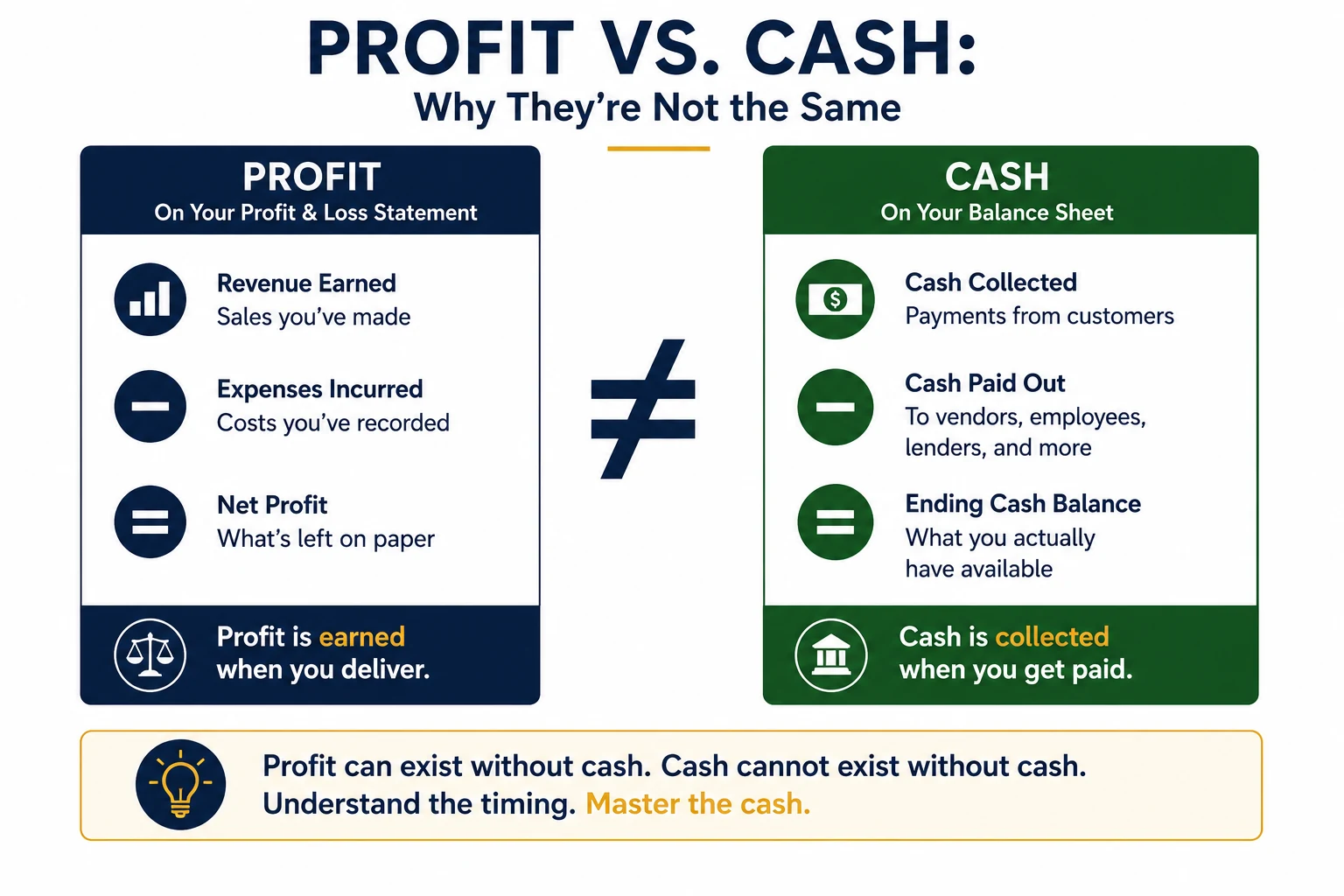
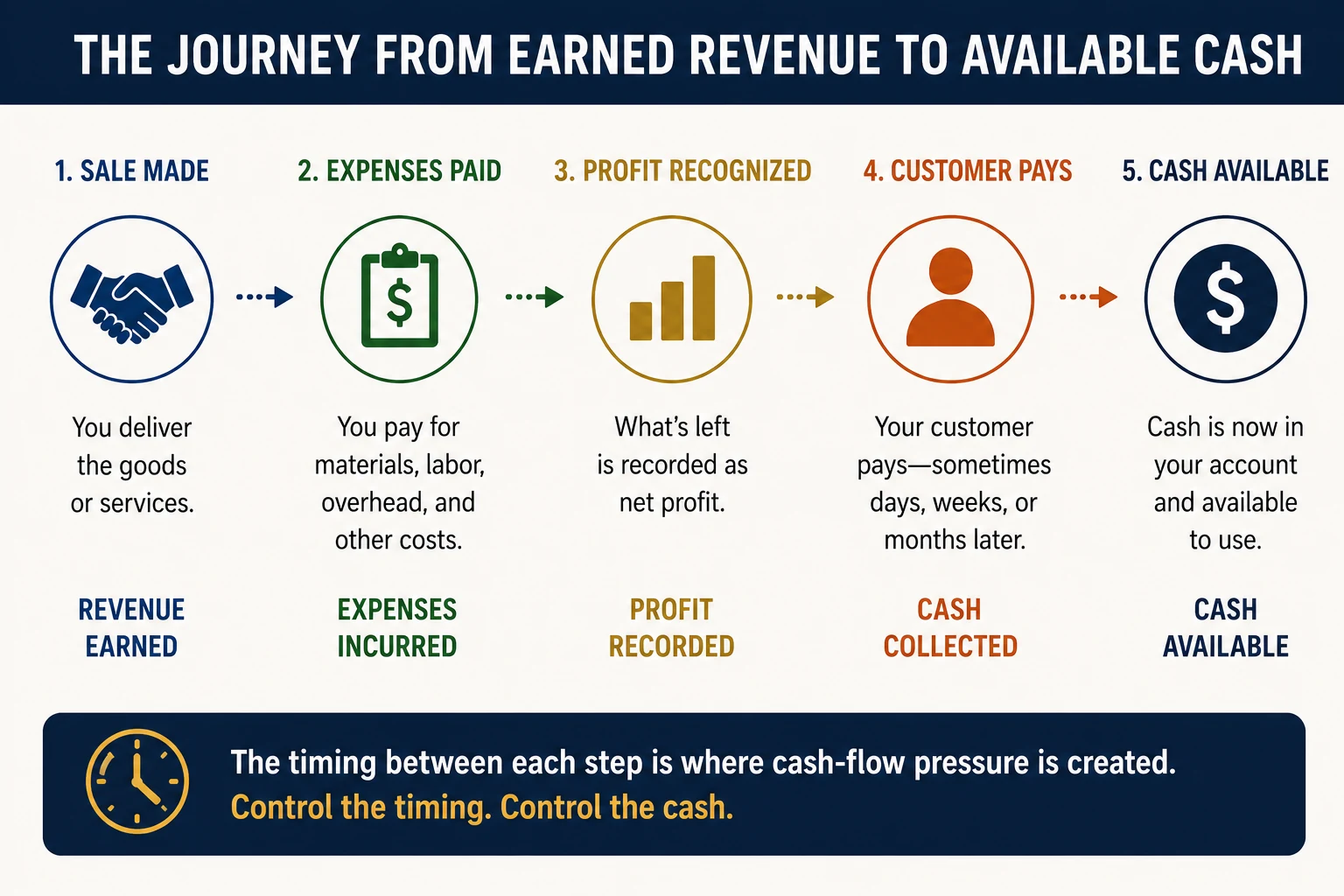
Between earning a profit and seeing cash in your checking account, a great deal can happen.
Customers may not have paid their invoices. You may have purchased inventory for upcoming projects. You may have invested in equipment to support future growth.
Loan principal payments may have reduced your bank balance even though they never appeared as an expense on your Profit & Loss statement.
Taxes, owner distributions, and other cash movements may have quietly reduced your available cash while leaving your reported profit unchanged.
Viewed together, your Profit & Loss, Balance Sheet, and cash position provide a complete picture of your business.
Viewed separately, each tells only part of the story.
Which naturally leads to the next question: If the cash didn’t disappear, where did it go?
The Five Cash Destinations
Cash rarely disappears without leaving clues. It simply goes to work somewhere else.
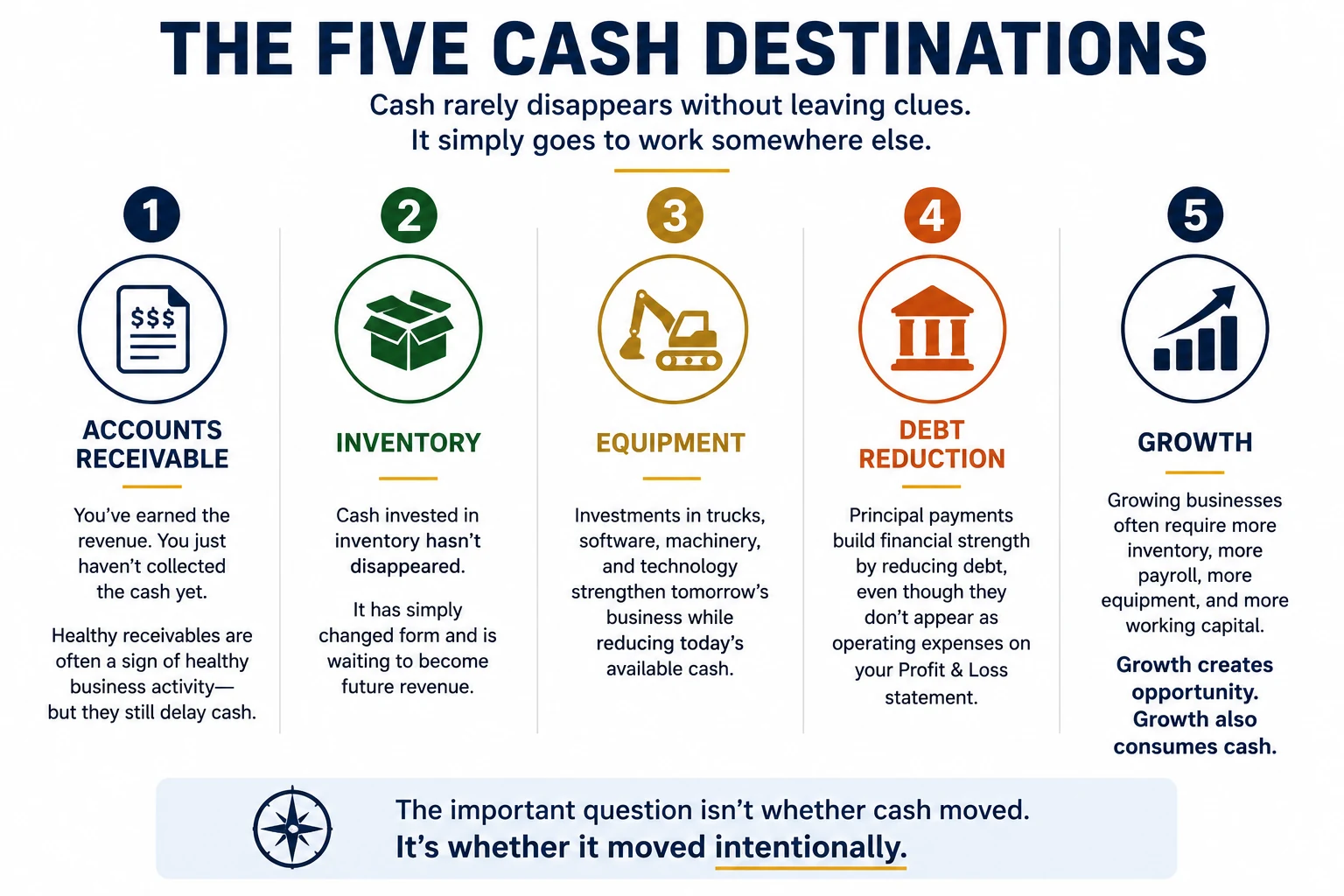
Accounts receivable delays cash you have already earned. Inventory changes cash into something intended to produce future revenue. Equipment strengthens tomorrow’s business while reducing today’s available cash. Debt principal payments build balance-sheet strength without appearing as operating expenses. Growth itself often requires more payroll, inventory, equipment, and working capital.
Growth creates opportunity. Growth also consumes cash.
The important question isn’t whether cash moved. It’s whether it moved intentionally.
Experienced financial leaders don’t ask, “How much cash do I have?”
They ask, “Why do I have this much cash?”
Every time your cash balance surprises you, ask three questions:
Start with the Profit & Loss statement.
Review receivables, inventory, equipment, debt, taxes, and owner distributions.
Intentional cash movement may indicate investment, growth, or a stronger balance sheet.
Put It Into Practice
The most successful business owners don’t make better decisions because they know more accounting. They make better decisions because they ask better financial questions.
Profit tells you whether your business is succeeding.
Cash determines whether your business can continue succeeding.
Final Thoughts
One of the greatest advantages a business owner can develop isn’t the ability to read financial statements.
It’s the ability to understand the story they’re telling.
Profit tells you how your business performed. Your Balance Sheet shows where your resources are invested. Your cash position tells you what your business is capable of doing next.
Viewed together, those reports stop being accounting documents.
They become management tools.
The better you understand that story, the more confidently you’ll lead your business through growth, uncertainty, opportunity, and change.
That’s exactly what financial clarity should provide.
Not more numbers. Better decisions.
Ready to See the Full Picture?
Every business has a financial story.
The question is whether you’re seeing the entire picture—or only part of it.
Our Business Financial Health Assessment is designed to help business owners understand how profitability, cash flow, financial reporting, and operational decisions work together so they can make more confident decisions for the future.
Because business owners shouldn’t have to guess.
They should know.
Next Week in Project Lighthouse
We’re busy… so why aren’t we making more money?
We’ll explore how gross margin—not revenue—is often the number that determines whether growth creates wealth or simply creates more work.