Your Numbers Are Telling You What to Do Next. Are You Listening?

Executive Brief
Good financial reporting should not merely tell you what happened. It should help you decide what happens next.
This is where financial decision making for business owners stops being theoretical. Whether you are considering another employee, a truck, a machine, or better software, the real question is not simply whether there is money in the bank.
The better question is: Can the business support the decision—and what must the investment accomplish?
Owners often begin a major decision by looking at the checking account. That is understandable, but the bank balance answers only one small part of the question.
The numbers should help us understand profitability, cash generation, margins, the work creating the demand, the full cost of the investment, and the cost of doing nothing.
We are not trying to talk an owner out of spending money. We are trying to see when spending money can make money.
Your Numbers Are Telling You What to Do Next. Are You Listening?
Business is busy.
Everyone is stretched thin. Jobs are stacking up. The phone keeps ringing. Your best employees are carrying more than they should, and you find yourself doing things you probably should not be doing anymore.
Eventually, somebody says it:
“We need another person.”
And they are probably right.
So you pull up the bank account.
There is $125,000 sitting there.
Looks pretty good.
You start thinking about salary, payroll taxes, benefits, maybe a truck or computer. You do some quick math in your head and decide:
“Yeah. We can afford it.”
Maybe you can.
But the balance in your bank account did not actually answer the question you asked.
The Question Is Not “Do We Have the Money?”
There is a big difference between:
Do we have enough cash to hire someone?
and:
Can the business support another employee?
The first question is about today. The second is about tomorrow, next month, and throughout the year.
That $125,000 sitting in the bank may look available, but some of it already has a job. Payroll is coming. Vendors need to be paid. Taxes are due. Loan payments are not going anywhere. Customers may have given you deposits for work you have not performed yet.
The business also needs enough cash left over to keep operating when collections slow down, an unexpected expense shows up, or business simply does not go according to plan.
That is your operating cash reserve—the financial breathing room that keeps every bump in the road from becoming an emergency.
It is also worth looking at working capital:
Working Capital = Current Assets − Current Liabilities
Working capital gives you a broader look at the short-term financial resources of the business after short-term obligations are considered. But working capital is not the same thing as cash. Receivables and inventory may be current assets, but neither one necessarily pays Friday’s payroll.
Cash in the Bank − Near-Term Obligations − Needed Cash Reserve = Cash You Can Actually Consider Putting to Work
Suddenly, having $125,000 in the bank is not quite the same as having $125,000 available to spend.
A New Employee Costs More Than Their Salary
Suppose you are considering hiring someone at $60,000 per year.
The cost is not simply $5,000 a month. There are payroll taxes, workers’ compensation, benefits, insurance, equipment, training and perhaps a vehicle, phone, software, or other expenses.
There is also something easy to overlook: time.
Your new employee may not be fully productive on Monday morning. Someone has to train them. They have to learn your systems. They need time to become efficient.
Before that employee contributes at full speed, the business may spend several months carrying much of the cost.
Remember Those Numbers We Have Been Talking About?
Over the past several Project Lighthouse lessons, we have looked at the numbers that tell us what is really happening inside a business.
Now we are going to put them to work.
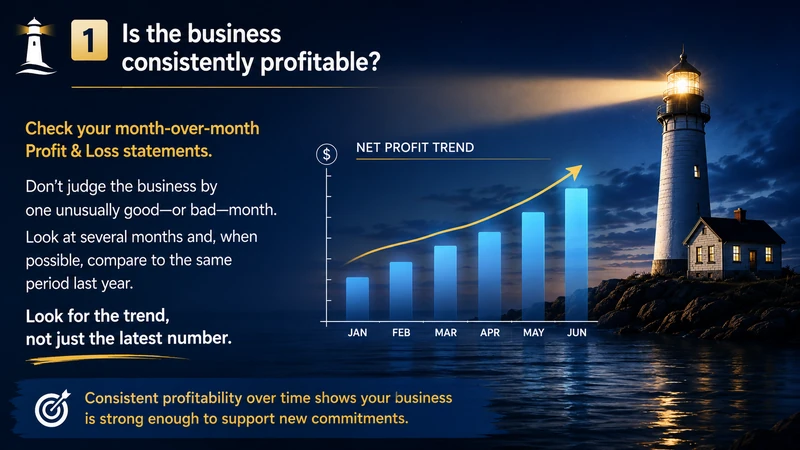
Is the business consistently profitable?
One good month does not tell us much. Reliable operating profit over time is very different from hiring because you just finished your best month of the year.
Is that profit turning into cash?
Profit and cash are not the same thing.
A profitable company can still be short on cash because money may be tied up in receivables or inventory—or used for equipment purchases, debt principal payments, owner distributions, and other items that do not appear the same way on the Profit & Loss statement.
Do not expect Net Profit and the change in your bank balance to match. Instead, understand why they do not.

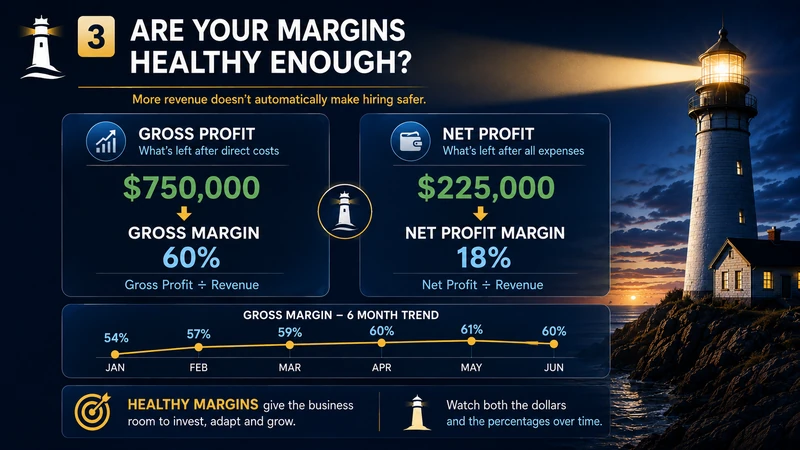
Are your margins strong enough?
More revenue does not automatically make hiring safer. If Gross Margin is slipping, adding another employee could simply add more cost to work that is not producing enough Gross Profit.
Sometimes the answer is not another employee. Sometimes it is better pricing, better production, or better work.
Where is the profitable work coming from?
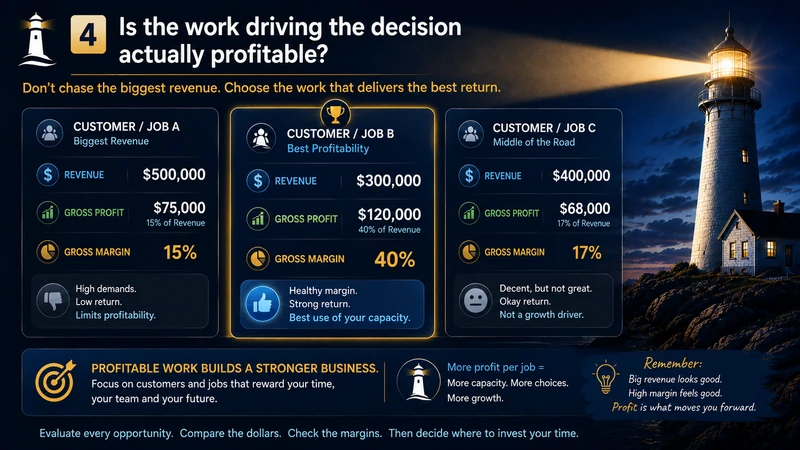
If you are hiring because one part of the business is growing, we should know whether that work is actually profitable.
A customer, department, or service producing lots of revenue but little profit may not be something we want to add capacity to support.
But What If Another Employee Is Not the Answer?
Maybe you need another truck. Or a machine. Or better equipment. Or software that eliminates hours of manual work.
Owners usually arrive at these questions for the same reason they started thinking about another employee:
Something is keeping the business from doing more, doing it better, or doing it faster.
So perhaps the question is not simply, “Can we afford another employee?”
Maybe it is:
“What does the business actually need to increase its capacity?”
The point is not that equipment is better than people—or people are better than equipment.
The point is that we should understand what problem we are trying to solve before we spend the money.
What Does the Investment Need to Do?
For the employee:
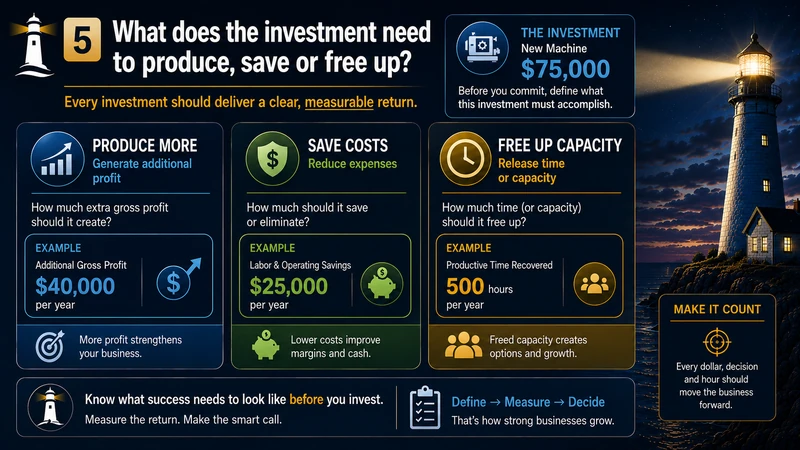
What does this person need to produce, save, or free up to justify the cost?
For the truck, machine, or equipment:
What does this asset need to produce, save, or speed up to justify the investment?
Do not measure the answer only in additional sales. An extra $100,000 of revenue means little if producing it costs $95,000.
What matters is the additional Gross Profit, cost savings, productive capacity, or owner and employee time the investment creates compared with its total cost.
Sometimes Not Spending the Money Is More Expensive
Businesses naturally worry about the cost of hiring another employee or buying equipment. They should.
But there is also a cost to doing nothing.
Maybe you are turning away profitable work because you do not have enough capacity. Maybe overtime keeps climbing. Maybe an old machine requires twice the labor of a newer one. Maybe a truck spends enough time in the repair shop that keeping it has become more expensive than replacing it.
Or perhaps you—the owner—are spending twenty hours a week doing work someone else could do while the things only you can do are not getting done.
The question is no longer only:
“What will this cost us?”
It is also:
“What is it costing us not to do it?”
Now We Are Thinking Like a CFO
We have not built a 47-tab spreadsheet. We have simply changed the questions.
Can the business support the investment?
What problem are we trying to solve?
What does the investment need to produce, save, or free up?
What happens if we do not make it?
Those are better questions—and your numbers can help answer them.
Pull out your latest financial statements and the last several months of results. Put the real numbers on the table, then run the decision through this checklist.
Check: Month-over-month Profit & Loss statements. Look for the trend and compare with the same period last year when possible.
Check: The profit trend against what is happening with cash. Understand the major differences—receivables, inventory, equipment, debt principal, and distributions.
Check: Gross Margin = Gross Profit ÷ Revenue × 100. Net Profit Margin = Net Profit ÷ Revenue × 100. Compare both over time.
Check: Customer, job, department, or service profitability. Review Gross Profit dollars and Gross Margin percentage—not revenue alone.
Check: The full cost against the additional Gross Profit, savings, labor hours, or capacity it is expected to create.
Check: Available cash, near-term obligations, working capital, operating reserve, and any new debt payment or cash outlay.
Check: Lost profitable work, overtime, repairs, downtime, wasted labor hours, delays, turnover, and owner time.
What Happens to Cash After We Make the Decision?
A good investment can still create a cash squeeze if the timing is not understood.
Ask when deposits, final payments, financing payments, training costs, and operating costs will occur—and when the expected benefits will begin.
Start with cash that truly is available after obligations and reserves, not the raw bank balance.

What Is It Costing Us to Do Nothing?
This is the cost that creates that nagging, pit-of-the-stomach feeling: the owner knows the business is busy, but also suspects money is being left on the table.
The P&L does not have an account called Money We Left on the Table. QuickBooks does not produce an Opportunities We Missed Because We Did Not Have Capacity report.
No vendor sends an invoice for owner hours spent doing work someone else could have handled.
But those costs can still be economically real.
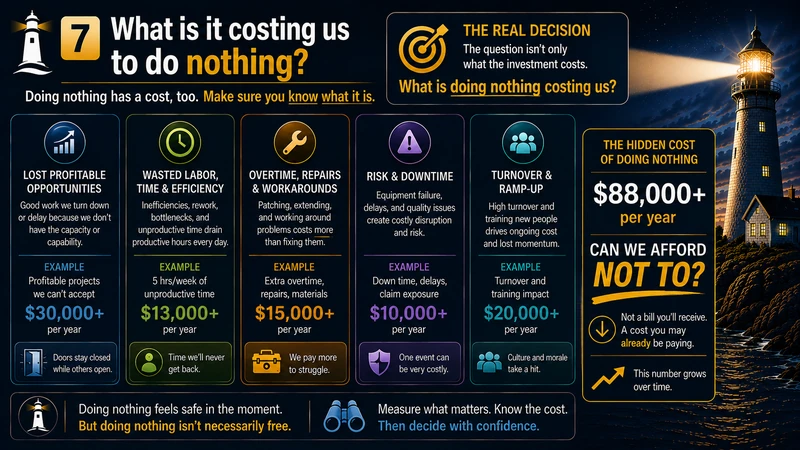
“Can we afford to do it?” is only half the decision.
“Can we afford not to?” is the other half.
Your Numbers Are Not There Just to Tell You What Happened
Most financial statements tell us about yesterday: last month’s sales, payroll, expenses, and profit.
That matters. But running a business entirely from historical financial statements is like driving while staring only at the rearview mirror.
Eventually, you have to look through the windshield.
Your financial information should help you decide whether to hire the employee, buy the truck, invest in equipment, raise the price, expand the operation—or leave things alone.
Sometimes the numbers will tell you something uncomfortable:
Spend the money.
Because the additional capacity, efficiency, or opportunity is worth more than the cost.
Other times they will tell you:
Not yet.
Both are valuable answers.
That is where the numbers stop being something your bookkeeper gives you at the end of the month.
They become a management tool.
And that is ultimately what Project Lighthouse is about: understanding where your business has been so you can make better decisions about where it is going next.
P.S. — More Tools Are Coming
These seven questions will take you a long way. In future Project Lighthouse lessons, we will look more closely at tools such as ROI, payback period, cash-flow forecasting, and debt-service coverage so you can evaluate larger decisions with even greater precision.
More tools. More clarity. Better decisions.
Ready to Put Your Numbers to Work?
Your business may not need more reports. It may need the right numbers, the right questions, and a clearer view of what the business can support.
Our Business Financial Health Assessment helps business owners connect profitability, cash flow, reporting, and operational decisions so they can make stronger decisions with greater confidence.