Don’t Start Your 2027 Budget With Last Year’s Numbers
Executive Brief
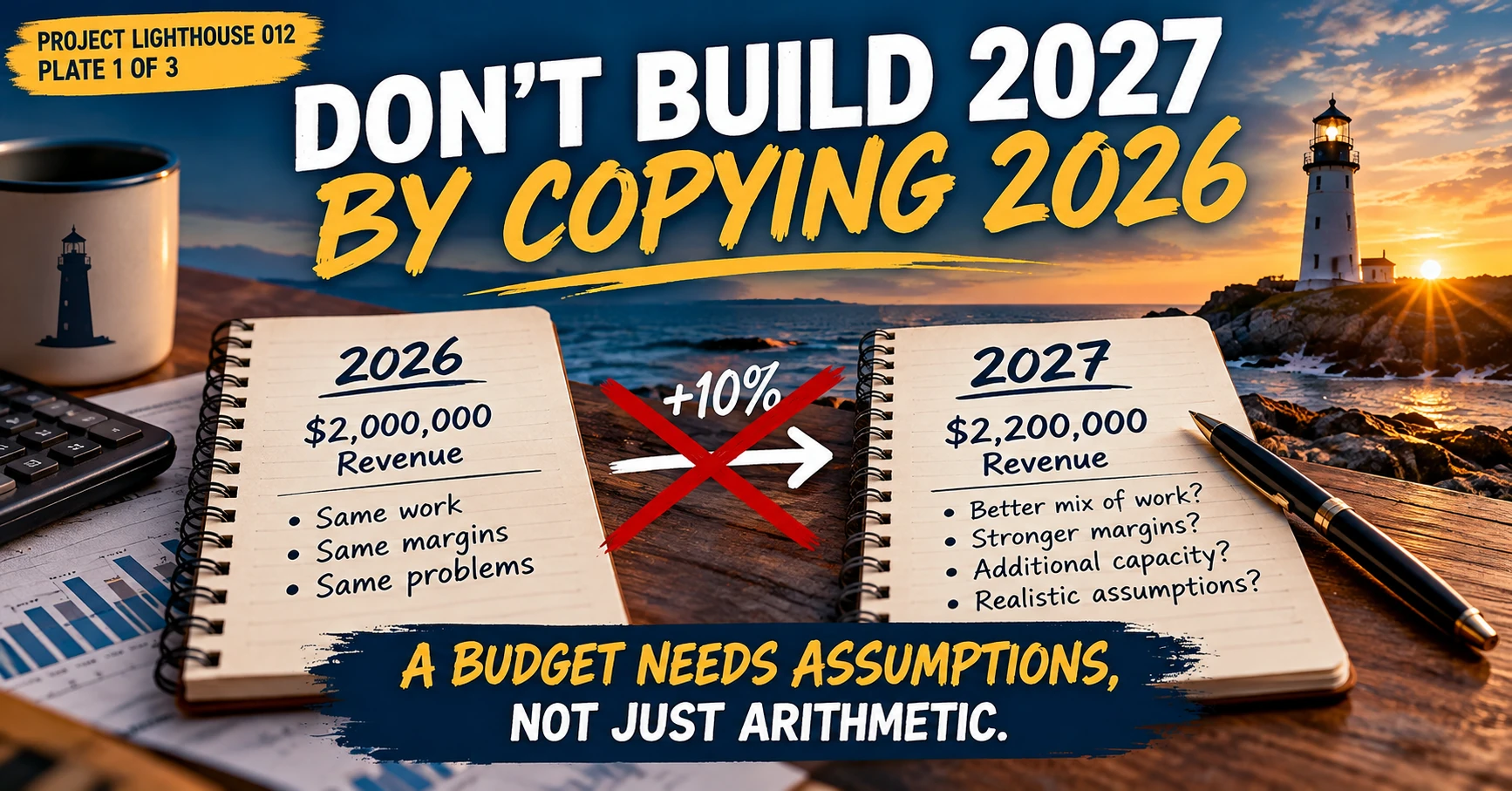
Don’t build your 2027 business budget by copying 2026 and changing the numbers.
A useful budget starts with what this year actually taught you about revenue, margins, expenses, capacity and cash. In this edition of Project Lighthouse, we follow one $2 million business and turn those lessons into a practical 2027 financial plan.
One of the easiest budgets to build is last year plus 10%.
It is also one of the easiest ways to carry last year’s problems into next year.
I want the budget to answer a different question: Based on what the business taught us this year, what needs to be different next year?
It’s October. For a lot of business owners, that means it’s time to start thinking about the 2027 business budget.
And budgeting often starts something like this: pull up last year’s numbers, increase revenue by 5% or 10%, add a little to payroll, adjust a few expenses, and save the spreadsheet.
2027 budget complete.
Except it isn’t really a budget.
It’s 2026 with different numbers.
A useful budget should answer a much more important question:
Based on what your business taught you this year, what needs to be different next year?
Build Your 2027 Business Budget Around What Actually Happened
By now, you have roughly nine months of 2026 behind you. That gives you something far more valuable than a blank budgeting template.
You have evidence.
You know—or should know—which parts of the business grew, which struggled, where margins improved, where costs crept up, which customers or jobs were profitable, and where cash got tight.
Before you budget 2027, ask:
Those answers should shape next year’s budget.
To see how, let’s follow a simple example. Suppose a business expects to finish 2026 with $2 million in revenue.
Revenue Isn’t the Whole Goal
The easiest budget in the world takes that $2 million and says:
2027 Revenue Goal: $2.2 million.
Ten percent growth. Sounds good.
But where is that additional $200,000 going to come from? More customers? Higher prices? Larger jobs? More recurring work? A new salesperson? Additional production capacity?
And maybe more importantly: Do you even want another $200,000 of the same work you did this year?
Suppose our $2 million company discovers that one type of work consistently produces strong margins while another generates plenty of revenue but very little profit.
Instead of simply asking how to grow from $2 million to $2.2 million, the owner can ask:
What kind of $2.2 million business do we want to build?
The goal isn’t simply more revenue. The goal is better revenue.
Protect the Margin Before You Chase the Sales
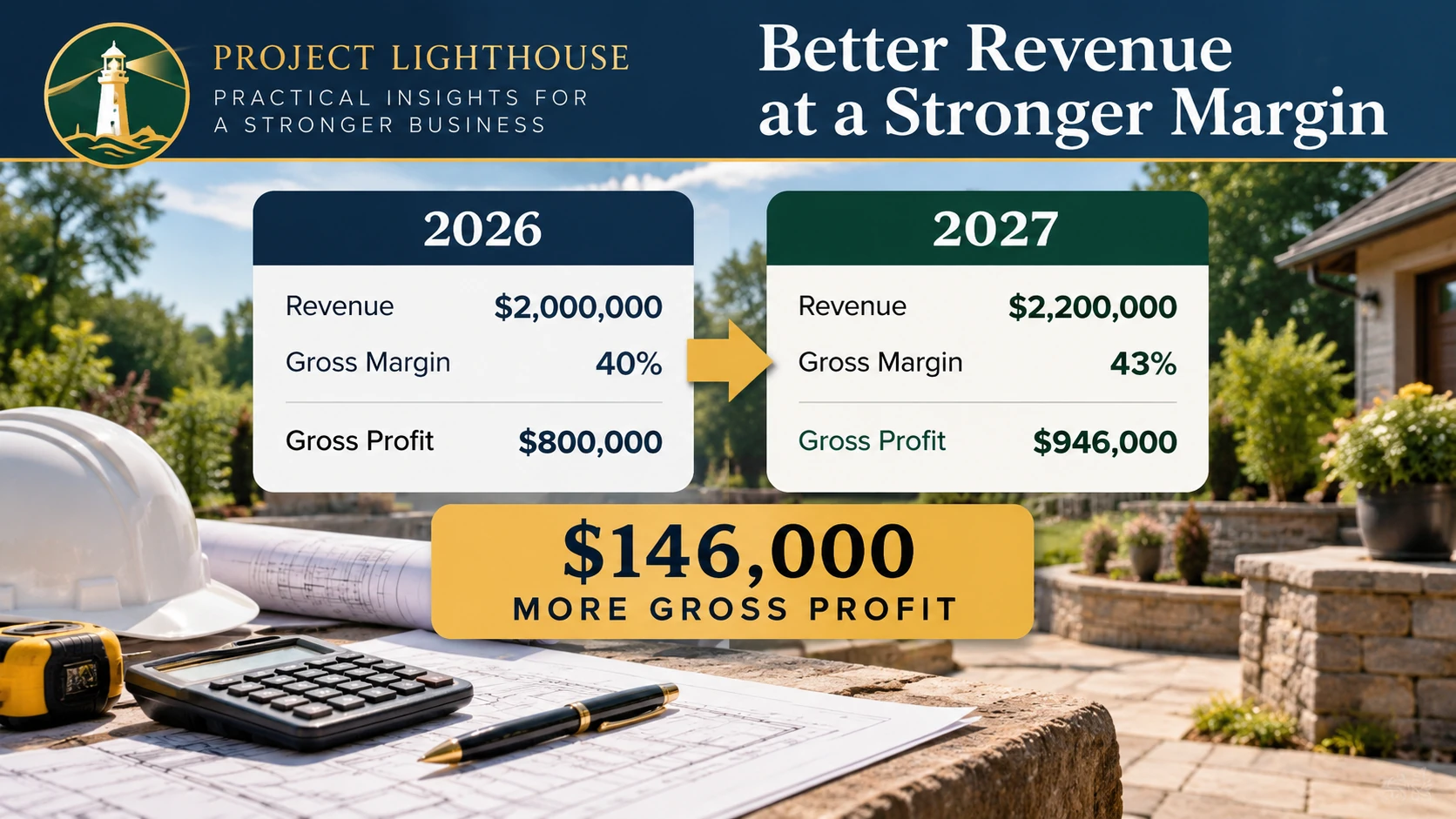
Let’s say our $2 million company is finishing 2026 with a 40% gross margin. That means $2 million in revenue produces $800,000 of gross profit.
Now suppose better pricing, tighter job costing, and a more profitable mix of work could move gross margin to 43% in 2027.
At $2.2 million of revenue, that would produce $946,000 of gross profit—$146,000 more than the business produced at $2 million and a 40% margin.
And notice something important: not all of that improvement came from selling more. Some came from making the work more profitable.
If your 2026 numbers showed shrinking margins, aggressive revenue growth without fixing the margin problem can make things worse. You may end up doing more work, managing more employees, carrying more receivables, and putting more cash at risk—without producing much more profit.
Don’t ask only, “How much do we want to sell next year?” Ask, “What gross margin should those sales produce?”
Build the Business You’ll Actually Need
Of course, that extra $200,000 of revenue probably doesn’t appear by magic.
Growth usually requires additional resources: people, equipment, vehicles, software, inventory, marketing, management, working capital, or additional production capacity.
Suppose our company determines that reaching $2.2 million will require another employee. The employee’s salary might be $60,000, but the cost of the employee isn’t necessarily $60,000.
There may also be payroll taxes, workers’ compensation, benefits, training, software, equipment, a vehicle, or other costs associated with putting that person to work. After accounting for everything, suppose the company expects the new position to cost $75,000 annually.
That $75,000 belongs in the 2027 plan—before the person is hired.
Do the same thing with equipment purchases, vehicles, marketing programs, software, or other investments the plan requires.
A budget should show you the financial consequences of your decisions before you make them.
Don’t Forget Cash
Here’s where our $2.2 million plan can still get into trouble.
Growth often consumes cash before it produces cash. Our company may have to make payroll, buy materials, pay subcontractors, carry additional receivables, and cover that new employee before the additional customer cash arrives.
So even if the budget shows a healthy profit, the owner still needs to ask: How much cash will this plan require?
Suppose the company decides it should never allow available cash to fall below $150,000. Now the budget has another guardrail.
If growth, equipment purchases, debt payments, or a seasonal slowdown would push cash below that level, management knows about the problem before the bank account announces it.
Budget Meets Cash Flow
A budget tells you where you want the business to go. A 13-week cash-flow forecast helps you see whether you have enough cash to get there.
If you haven’t built one yet, our Project Lighthouse 13-Week Cash Flow Forecast walks you through the process and includes a tool you can use to start looking ahead instead of managing from today’s bank balance.
And Then There’s the Owner
There’s still one important question missing from our example:
What does the business need to produce for the owner?
Not just enough to pay its bills. Not just enough to show a profit.
What does the owner need the business to provide in salary or compensation, distributions, retirement contributions, debt reduction, reserves, or long-term wealth creation?
Our fictional company can build a perfectly respectable $2.2 million budget. But until we answer that question, we still don’t know whether it’s the right $2.2 million business.
Your business isn’t just there to pay its bills and survive another year. It exists for a reason. Your financial plan should reflect that reason.
Six Numbers Worth Putting on the Wall
Let’s bring our example together. Our $2 million company isn’t simply adding 10% to last year’s revenue anymore. It’s starting to build an actual 2027 financial plan.
| 2027 Target | Example |
|---|---|
| Revenue | $2,200,000 |
| Gross Profit — 43% | $946,000 |
| Operating Expenses | $650,000 |
| Net Profit | $296,000 |
| Minimum Cash Reserve | $150,000 |
| Owner Compensation / Return | ??? |
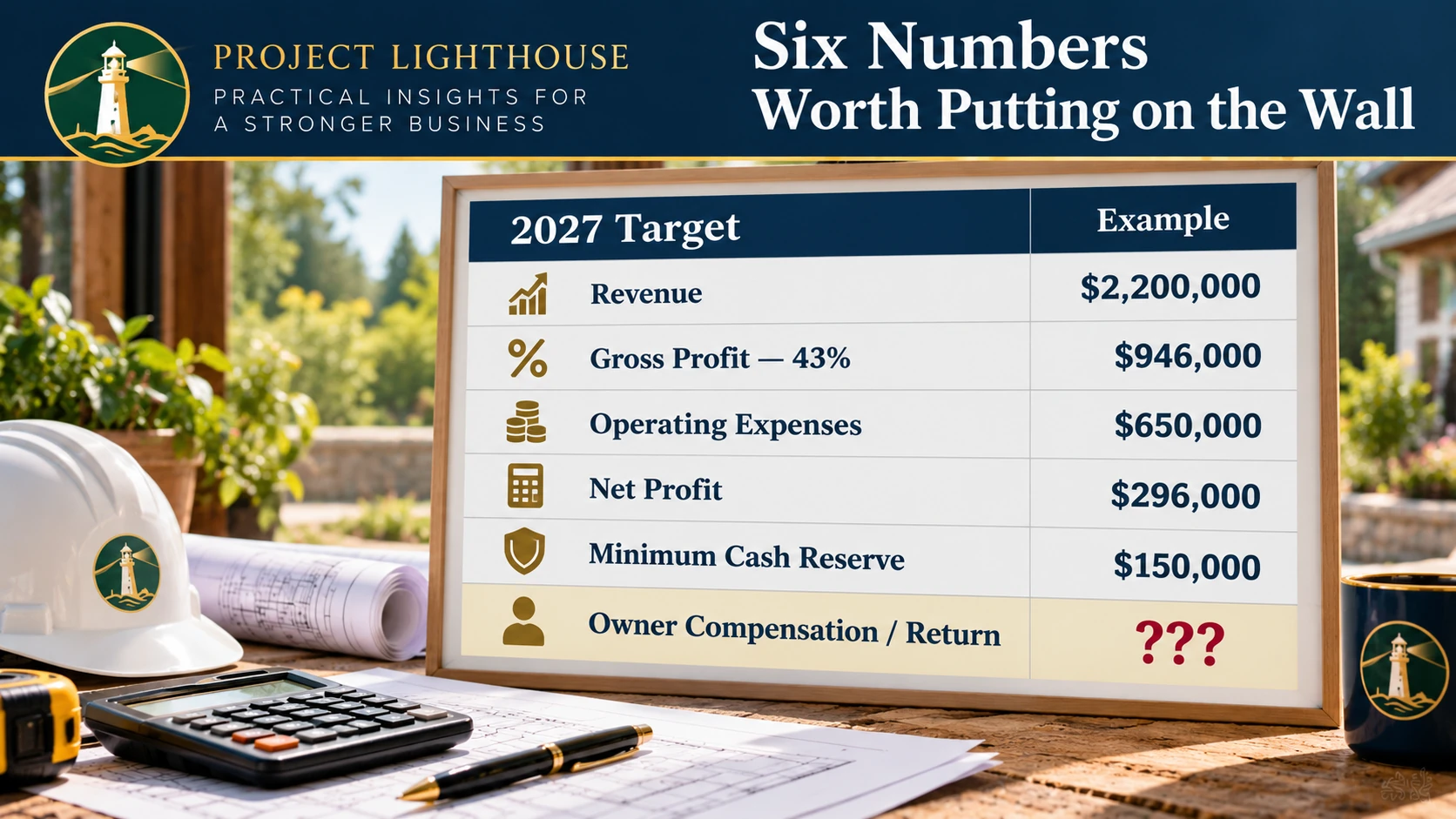
That last number is intentionally blank because it deserves more thought than whatever happens to be left over at the end of the year.
These numbers don’t need to be perfect on the first try. They need to be intentional, and they need assumptions behind them.
Pressure-test the plan
What specifically will produce the additional revenue?
What pricing, job mix or operating changes will improve margin?
People, equipment, overhead and capacity need to be in the plan before the costs arrive.
Profitability does not eliminate working-capital needs.
That number belongs in the plan too.
A Budget Should Help You Make Decisions
The best budget isn’t the one with the prettiest spreadsheet. It’s the one you actually use.
That means taking the annual plan and breaking it into meaningful monthly targets based on how your business actually operates. If your business is seasonal, twelve equal monthly revenue targets probably aren’t particularly useful.
Then, when March sales are 8% behind plan, you know what that actually means.
When someone asks whether you can afford another employee, the budget should help answer. When a major equipment purchase comes up, the budget should help answer. When margins start slipping, you should know quickly enough to do something about it.
That’s when budgeting stops being an accounting exercise.
It becomes a management tool.
For additional small-business financial-management guidance, the U.S. Small Business Administration also provides resources on managing business finances.
Use what 2026 taught you to make better decisions in 2027—before the decisions are made for you.
Next Week
We left one number blank:
Owner Compensation / Return: ???
That wasn’t an accident.
Next week, we’re going to turn the question around. Instead of asking “How much can the business make?” we’re going to ask:
How much does the business need to make—for you?
Then we’ll work backward from the owner’s goals to determine what the business actually has to produce to make those goals possible.
One Comment