Can Your Business Afford It? A Simple Small-Business ROI & Payback Test

Executive Brief
ROI for small business investments doesn’t need to be complicated. A business investment can fit comfortably into the monthly budget and still be the wrong financial decision.
In this edition of Project Lighthouse, we use one $40,000 investment to look at Return, Payback, and Cash—three simple questions that help determine what an investment must produce, how long it will take to earn the money back, and whether the business can comfortably survive the wait.
Business owners do not need a complicated financial model every time they buy a truck, piece of equipment, or new software.
But before spending the money, I want to know what the investment is expected to produce, how long it will take to earn that money back, and what happens to cash while we wait.
Sometimes the numbers say yes. Sometimes they say not yet. And occasionally they save us from a very expensive no.
You’re thinking about buying a $40,000 piece of equipment.
Maybe it’s a truck. A machine. New software. Something that would let your team get more work done or do it more efficiently.
You talk to the salesperson. They show you the financing options. You look at the monthly payment.
And you think:
“Yeah. We can handle that.”
So, you can afford it…right?
Maybe.
But whether you can make the payment and whether you should make the investment are two very different questions.
Before you commit $40,000 of your company’s money, there’s a better question to ask:
What does this investment have to produce for my business?
That one question changes the conversation.
Start With What Comes Back
Every business investment should have a job. And when you’re looking at ROI for a small business investment, the first step is figuring out what that investment is realistically expected to produce.
Maybe the new equipment lets you complete more jobs each month. Maybe it eliminates work you currently subcontract. Maybe automation saves employee hours. Maybe a new vehicle allows another crew to operate.
Whatever the reason, try to put a realistic dollar value on the benefit.
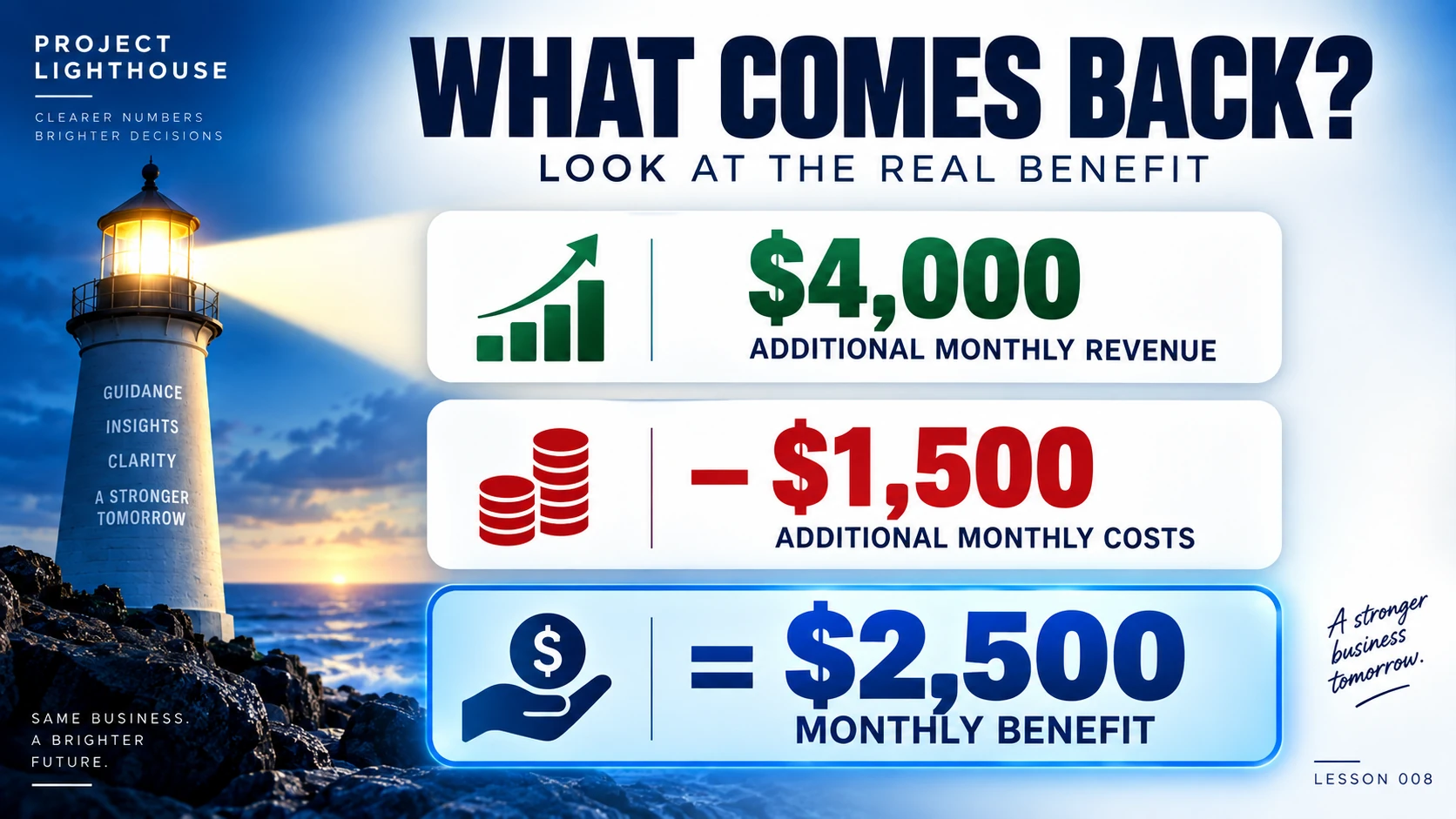
For our example, let’s say the $40,000 investment is expected to generate $4,000 per month of additional revenue.
But producing that revenue will also require about $1,500 per month of additional operating costs — labor, fuel, maintenance, supplies or whatever else is necessary to make the investment productive.
So our starting point looks like this:
$4,000 Additional Monthly Revenue
− $1,500 Additional Monthly Costs
= $2,500 Expected Monthly Benefit
Notice that we’re not evaluating the investment using the $4,000 of additional revenue.
We’re using the $2,500 that actually improves the business.
Now we have something we can work with.
First, Look at Payback
One of the simplest ways to evaluate an investment is its payback period.
The calculation is pretty straightforward:
Investment ÷ Monthly Benefit = Payback Period
Using our example:
$40,000 ÷ $2,500 = 16 months
So, if our assumptions hold, it takes about 16 months for the investment to generate enough additional benefit to recover the original $40,000.
That’s useful information.
You’re no longer simply looking at a purchase price or monthly payment.
You know approximately how long your money will be tied up before the investment has earned it back.

Next, Look at Return
Now let’s look at ROI for small business investments using a simple return-on-investment calculation.
Our expected monthly benefit is $2,500.
Over 12 months:
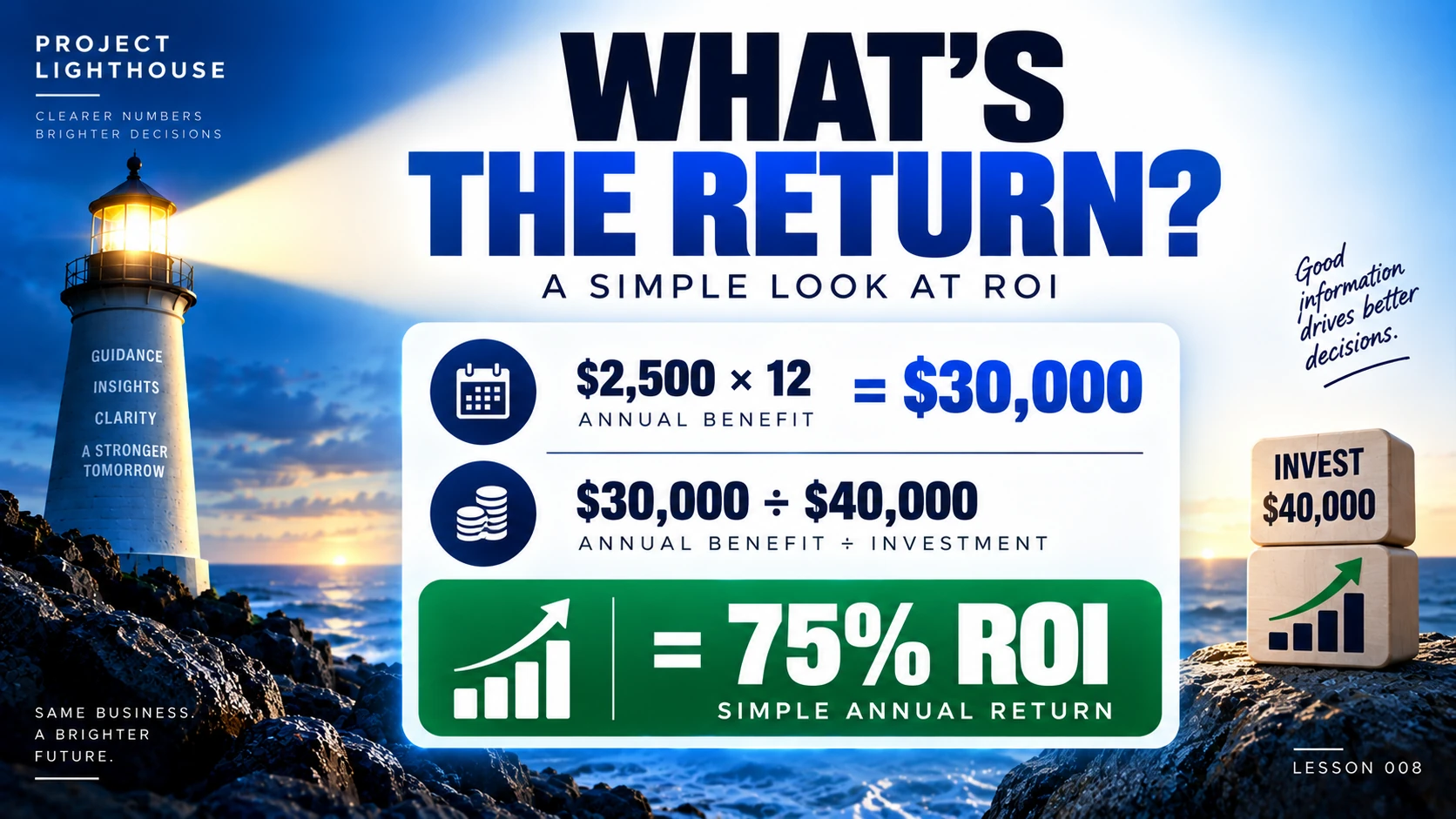
$2,500 × 12 = $30,000
Compare that annual benefit with our $40,000 investment:
$30,000 ÷ $40,000 = 75%
That’s a 75% simple annual ROI based on our assumptions.
On the surface, that sounds pretty attractive.
But there are three words in that last sentence that matter a whole lot:
Based on our assumptions.
Because spreadsheets are wonderfully obedient.
Put $2,500 into the spreadsheet and it will happily tell you the investment pays for itself in 16 months.
The spreadsheet won’t ask whether $2,500 is realistic.
You have to.
Now Let’s Make the Numbers Misbehave
This is where I like to push on the numbers a little.
Our expected monthly benefit is $2,500.
But what happens if the investment doesn’t perform exactly as expected?
Maybe the new equipment doesn’t increase production as quickly as planned. Maybe the labor savings aren’t quite as large. Maybe it takes several months before your team is using the new system efficiently.
Let’s stress-test the same $40,000 investment.
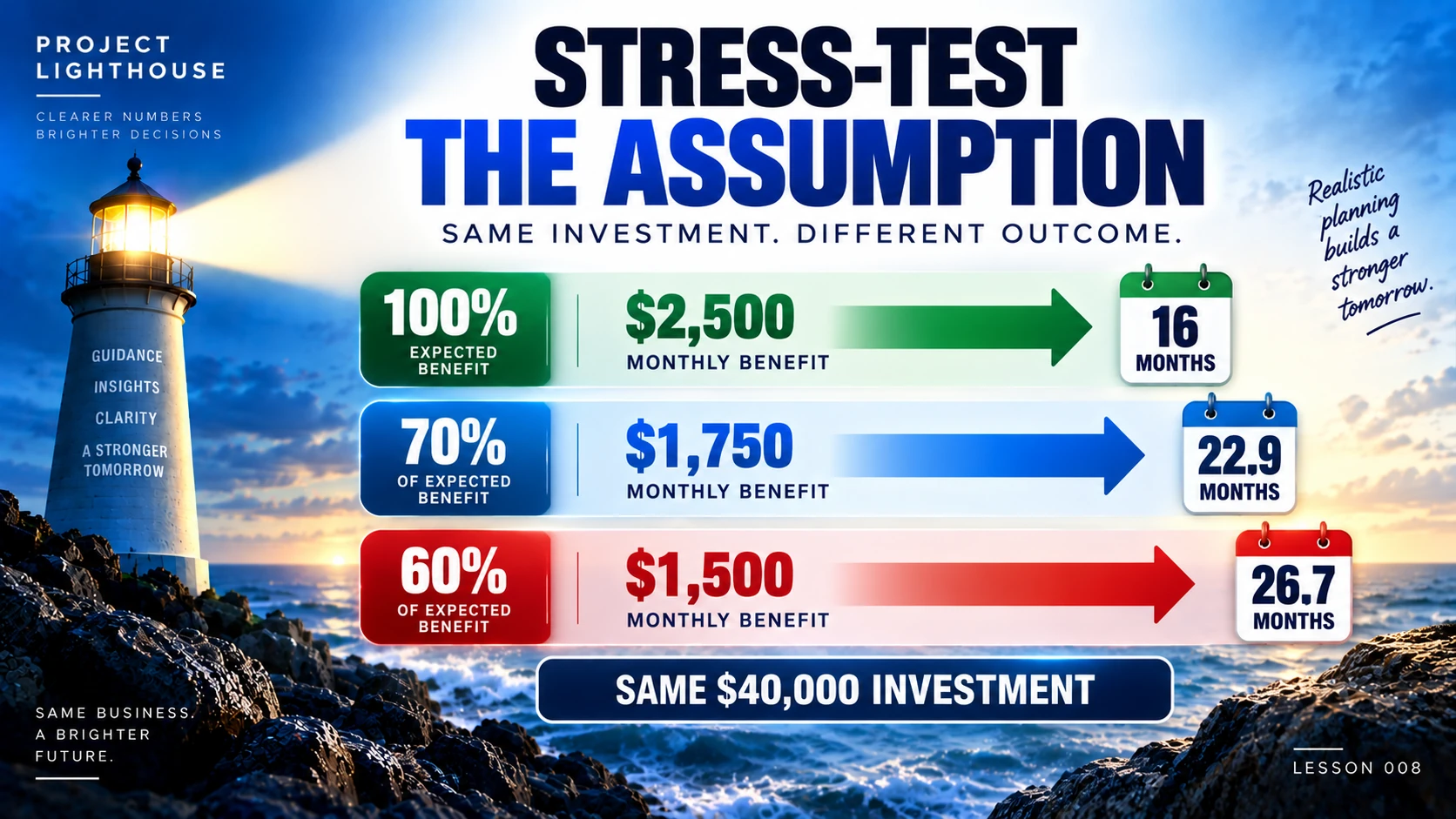
At 100% of our expected benefit — $2,500 per month:
Payback = 16 months
At 70% — $1,750 per month:
Payback = 22.9 months
At 60% — $1,500 per month:
Payback = 26.7 months
Nothing about the purchase changed.
It’s still the same $40,000 investment.
Only our assumption about what it will produce changed.
And suddenly our 16-month payback could become almost 27 months.
That’s why I wouldn’t evaluate an investment using only the number I hope will happen.
Run the expected case.
Then make the numbers misbehave.
If this investment produces only 60% or 70% of what I’m expecting, does the decision still make sense?
If the answer is yes, you may have a pretty solid investment.
If the whole thing falls apart when one assumption changes, that’s something worth knowing before you sign.
Make Sure You’ve Found the Hidden Costs
Remember the $1,500 of additional monthly costs we included at the beginning?
Now’s the time to challenge that number too.
Did we capture everything?
If it’s a truck, did we include fuel, insurance, maintenance and the labor required to operate it?
If it’s a machine, did we include training, repairs, supplies or additional labor?
If it’s software, did we include implementation, subscriptions and employee time?
The point isn’t to make the investment look bad.
The point is to make the numbers realistic.
If we discover another $500 per month of costs we hadn’t considered, our expected benefit isn’t $2,500 anymore.
It’s $2,000.
And now our payback moves from:
16 months → 20 months

Same $40,000 purchase.
Better information.
That’s why the purchase price is only the beginning of the decision.
Then There’s Cash
Here’s where a perfectly good investment can still become a bad decision.
Suppose we’ve done our homework.
The expected return looks attractive.
The payback period makes sense.
Even after stress-testing the assumptions, we still like the investment.
Great.
But what happens if spending that $40,000 leaves the business short on cash?
You still have payroll.
Vendors still need to be paid.
Taxes will come due.
And businesses have an annoying habit of occasionally having slow months at exactly the wrong time.
An investment can make perfect economic sense over the next three years and still create a cash problem over the next three months.
That’s why return and payback can’t make this decision by themselves.
And financing doesn’t completely eliminate the question.
Financing may allow you to keep more cash in the business today, but now you’ve introduced monthly debt payments and interest that also have to be supported by future cash flow.

So before making the investment, I want to know three things.
Not the sales pitch.
Not the best-case scenario.
What do you reasonably expect the business to gain after the additional costs required to make the investment work?
If you’re committing $40,000, know whether you’re expecting to recover that investment in 12 months, 24 months, 36 months or longer.
Time matters.
Look beyond the purchase.
What happens to cash reserves?
Can you still comfortably cover payroll, vendors, taxes, debt payments and normal operating expenses?
And what happens if the investment takes longer than expected to produce results?
RETURN tells you what the investment is expected to produce.
PAYBACK tells you how long it takes to earn your money back.
CASH tells you whether the business can comfortably survive the wait.
A good investment doesn’t just fit into your budget. It earns its place in your business.
Bringing It All Together
A good investment is not simply one with an attractive return.
It is one whose return is realistic, whose payback period makes sense, and whose timing does not put the business under unnecessary cash pressure.
Before you sign, finance, or write the check, ask three questions:
What will it produce? How long until we earn it back? Can we comfortably survive the wait?
Those questions will not eliminate uncertainty. They will make the decision considerably clearer.
Want to Know What Your Numbers Are Telling You?
Good financial decisions start with understanding the financial health of the business making them.
Our Business Financial Health Assessment helps business owners connect profitability, cash flow, reporting, and operational decisions so they can make their next investment with greater clarity.
Next Week in Project Lighthouse
When does financing help a business—and when does debt quietly become the problem?
We will look at how debt service affects cash flow, flexibility, and the financial breathing room a growing business needs.