Slow-Paying Invoices: The Hidden Cost to Your Business


Your business completes the work, sends the invoice, and records the revenue. Everything looks good—except the money hasn’t arrived.
Meanwhile, payroll is due Friday. Vendors expect payment. Insurance, rent, and operating expenses don’t wait.
Your customers may be paying their bills. But how much of your working capital are they using while you wait?
That’s a question worth asking.
THow Slow-Paying Invoices Tie Up $164,000 in Receivables
Consider a business generating $1 million annually in credit sales—approximately $2,740 per day. At an average 60-day collection period, approximately $164,384 is tied up in receivables. At 30 days, that falls to $82,192.

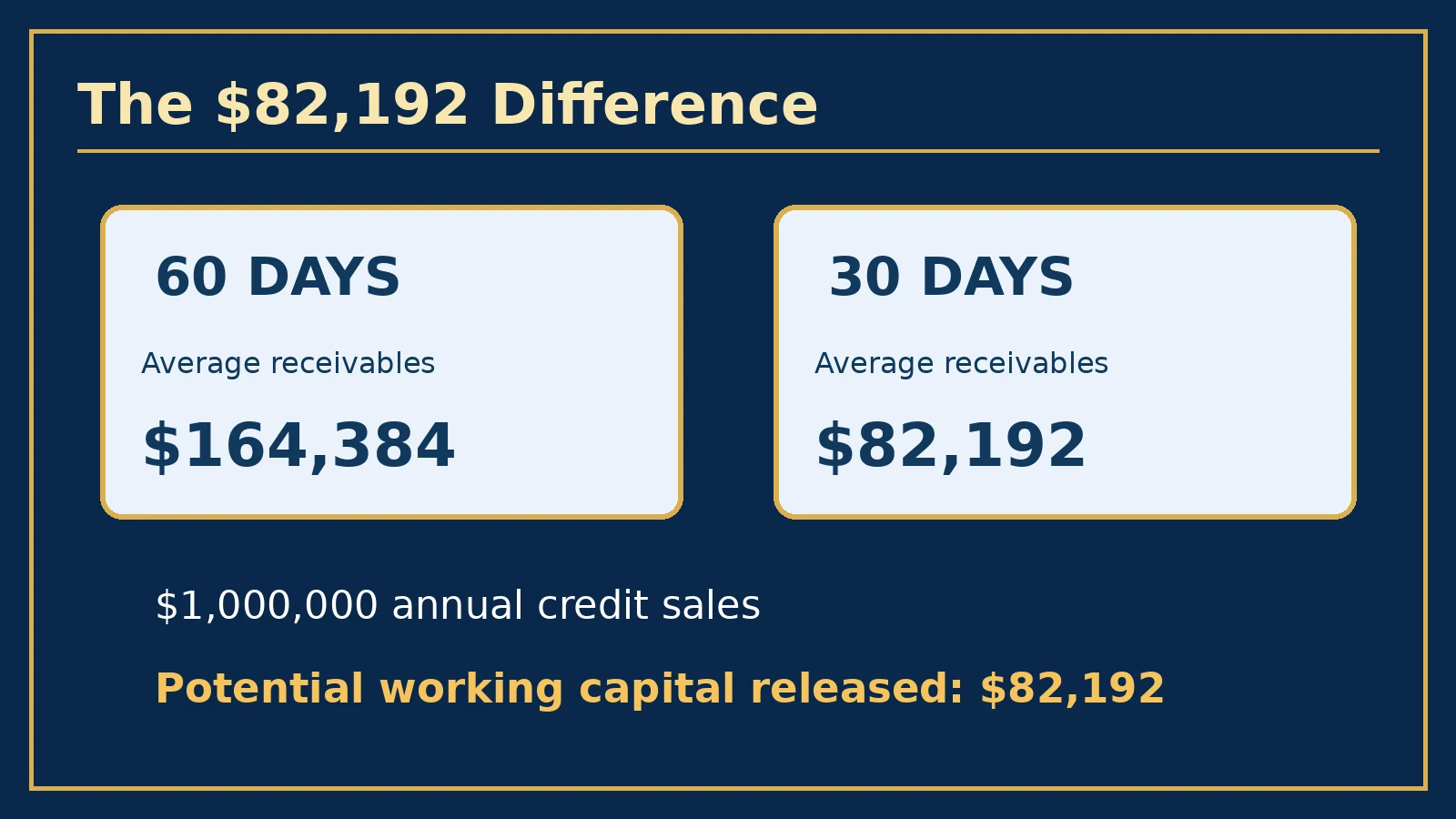
That $82,192 is not additional profit. It is a potential one-time release of working capital as the collection cycle improves, assuming steady credit sales.
What Slow-Paying Invoices Could Cost Your Business Every Year
If the business finances its receivables with a line of credit at 10% annual interest, and faster collections permanently reduce outstanding borrowing by $82,192, the potential interest savings are $82,192 × 10% = $8,219 annually.
The cash release happens once; the borrowing-cost savings can recur for as long as the lower debt balance and interest rate hold. If the business does not borrow to fund receivables, it will not realize those direct interest savings, although faster collections still improve liquidity.
How DSO Reveals the Impact of Slow-Paying Invoices
Days Sales Outstanding (DSO) estimates how many days of credit sales are tied up in receivables.
DSO = (Average Accounts Receivable ÷ Annual Net Credit Sales) × 365
At $164,384 in average receivables and $1 million in annual credit sales, DSO is about 60 days. Lower DSO generally means faster collection, but terms matter: Net 60 customers paying on day 60 are not necessarily late.
Compare DSO With Your Payment Terms
DSO − Standard Payment Terms ≈ Collection Delay Beyond Terms. With Net 30 terms and 55-day DSO, collections are roughly 25 days beyond terms. This is only a rule of thumb: customer-specific terms, retainage, seasonality and billing patterns can distort it.
Your A/R Aging Report and DSO Tell Different Stories
An A/R aging report identifies who owes you money and which invoices are overdue. Suppose the balances are $75,000 current, $35,000 1–30 days overdue, $25,000 31–60 days overdue, and $15,000 more than 60 days overdue. Total A/R is $150,000.
Against $1 million in annual credit sales, that ending balance represents roughly 55 days of sales outstanding. Formal DSO based on average receivables may differ.

Older overdue invoices can be more difficult to collect in full, making weekly review important.
A Special Consideration for Contractors: Retainage
Construction contracts may withhold part of progress billings as retainage until completion or other milestones. Retainage may be recorded as a receivable without being contractually due yet. Track it separately from overdue trade receivables to avoid misreading collection performance.
Should You Offer a Discount to Get Paid Faster?
Under 2/10 Net 30, a customer receives a 2% discount for paying within 10 days instead of the full amount at 30 days. Giving up $2 to collect $98 twenty days sooner has a simple annualized financing cost of (2 ÷ 98) × (365 ÷ 20) ≈ 37.2%—far more than a 10% line of credit.
This assumes the customer otherwise pays in full on day 30 and the discount accelerates payment by 20 days. Actual economics depend on payment behavior, collection risk and available financing. Early-payment discounts can still be useful, but should be evaluated rather than offered automatically.
Five Ways to Stop Financing Your Customers Unnecessarily
- Invoice promptly. Bill when work or milestones become billable.
- Set terms before work. Agree on deposits, due dates and progress payments in writing.
- Review aging weekly. Resolve disputes and pursue overdue balances before they become old.
- Make payment easy. Use automated reminders, ACH invoice links and a written, contract-compliant credit-hold or stop-work policy.
- Track DSO. Compare trends with payment terms and investigate deterioration.


What Should You Do This Week?
Ask: How much is in A/R? How much is overdue under agreed terms? Is DSO improving or worsening? Review your largest overdue balances and determine whether the issue is billing, disputes, terms or follow-up.
For the broader monthly reporting context, read What Financial Reports Should a Small Business Review Every Month?
The Lighthouse Takeaway
Revenue tells you what you’ve sold. Profit tells you what you’ve earned. Collections determine when that money becomes available to use.
You don’t necessarily need more customers or more sales to improve cash flow. Sometimes you need to collect what you’ve already earned.
Put Your Numbers to Work
Explore the 13-Week Cash Flow Forecast lesson and take our Business Financial Health Assessment.
For more on collection metrics, see the Association for Financial Professionals’ DSO guidance.