Small Business Cash Reserve: How Much Is Enough?
A small business cash reserve isn’t simply the money sitting in your checking account. It’s cash deliberately protected to keep your business operating when collections slow, expenses rise, or something unexpected happens.


The $100,000 Question
Two businesses each have $100,000 in checking. One enjoys predictable collections; the other faces payroll, taxes and a seasonal slowdown. Same balance, very different financial positions. The question is not merely how much cash is in the bank, but how much the business needs, when it needs it and how reliably it will be replenished.
How to Calculate Your Small Business Cash Reserve
A small business cash reserve is money deliberately protected to meet obligations when collections slow or expenses surprise you. It buys time to respond without immediately relying on emergency financing. It is a management policy, not simply whatever is left in checking.
The Three-to-Six-Month Rule Is a Starting Point
Three to six months of essential cash obligations is a common planning reference, not a universal requirement. Stable recurring revenue, concentrated customers, debt, seasonal exposure and collection delays all change the appropriate cushion.
Start With Essential Cash Obligations
The U.S. Small Business Administration’s guide to managing business finances offers additional background on financial records and cash-flow management.
Our illustrative $1 million-revenue business requires $24,000 for payroll and related taxes, $6,000 for rent, utilities and insurance, $9,000 for essential vendors, $4,000 for required loan payments and $2,000 for other unavoidable commitments: $45,000 per month. Unlike a P&L expense total, this cash measure includes loan principal and excludes noncash depreciation. Forecast scheduled distributions and owner tax funding separately as appropriate; avoid treating an owner’s personal income taxes automatically as company expenses.
Minimum Versus Target
For this small business cash reserve policy, at $45,000 a month, two months equals $90,000 and four months equals $180,000. Management chooses $90,000 as its minimum cash floor and $180,000 as its longer-term target. Neither number is mandatory. The minimum is compared with projected cash at the same point in time; it is not an additional expense to deduct from cash payments.
The $100,000 Cash Illusion
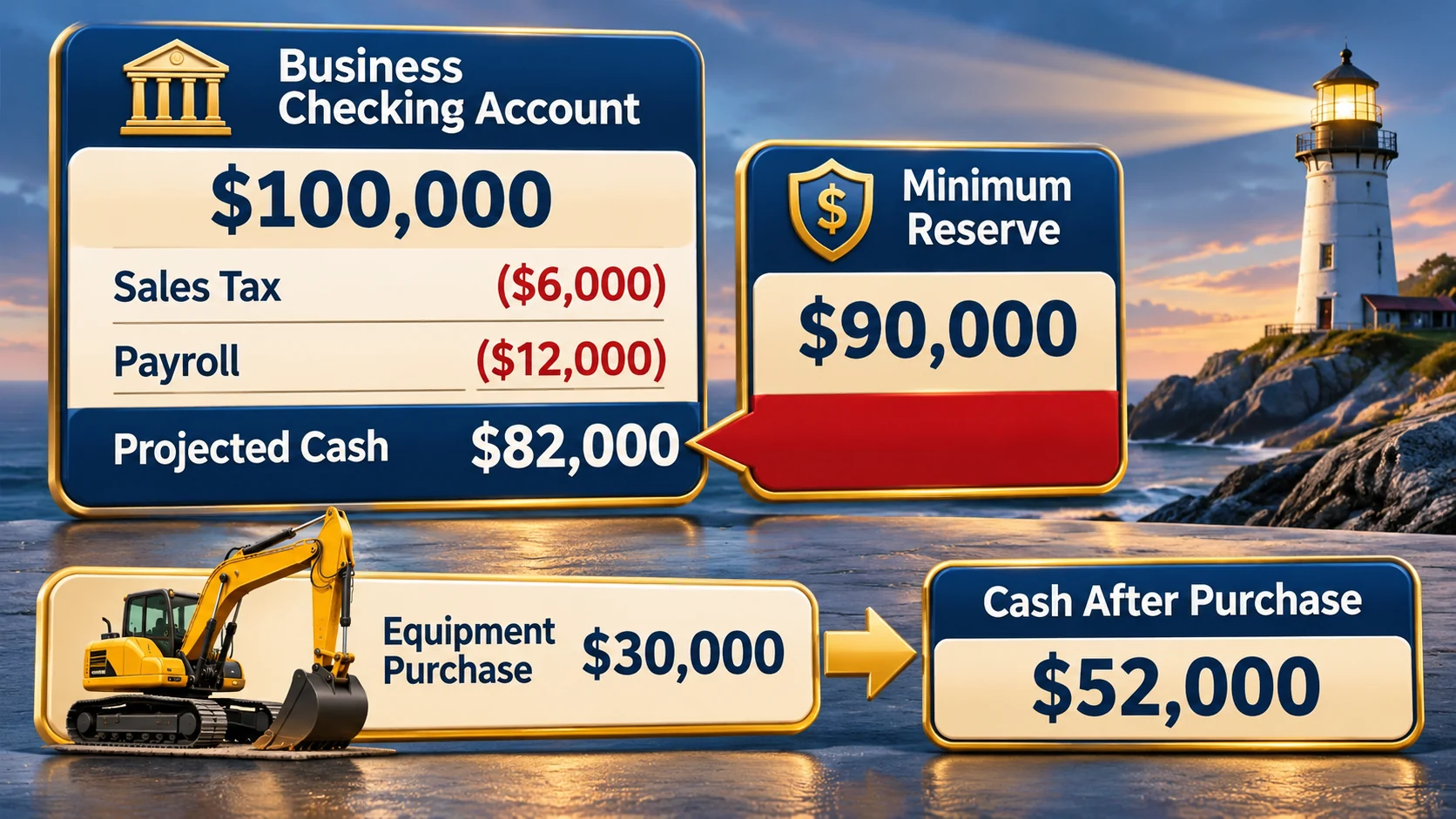
The bank shows $100,000. Sales tax collected and due is $6,000, and payroll due Friday is $12,000. Assuming no intervening receipts or other payments, cash after those payments will be $82,000—$8,000 below the $90,000 minimum. Payroll is already included in the $45,000 monthly obligations; we are illustrating its timing, not subtracting it twice. A $30,000 equipment purchase would leave $52,000, further below the policy floor. The real question is whether the business can absorb that purchase after considering forecast collections and commitments.

Build Toward the Target
Once cash is restored to $100,000, the $180,000 target is $80,000 away. Setting aside $5,000 of genuinely surplus cash each month would take about 16 months, assuming no withdrawals or other changes. Reserve contributions must follow payroll, taxes, debt service, operating needs and planned distributions.
Plan for Seasonal Gaps
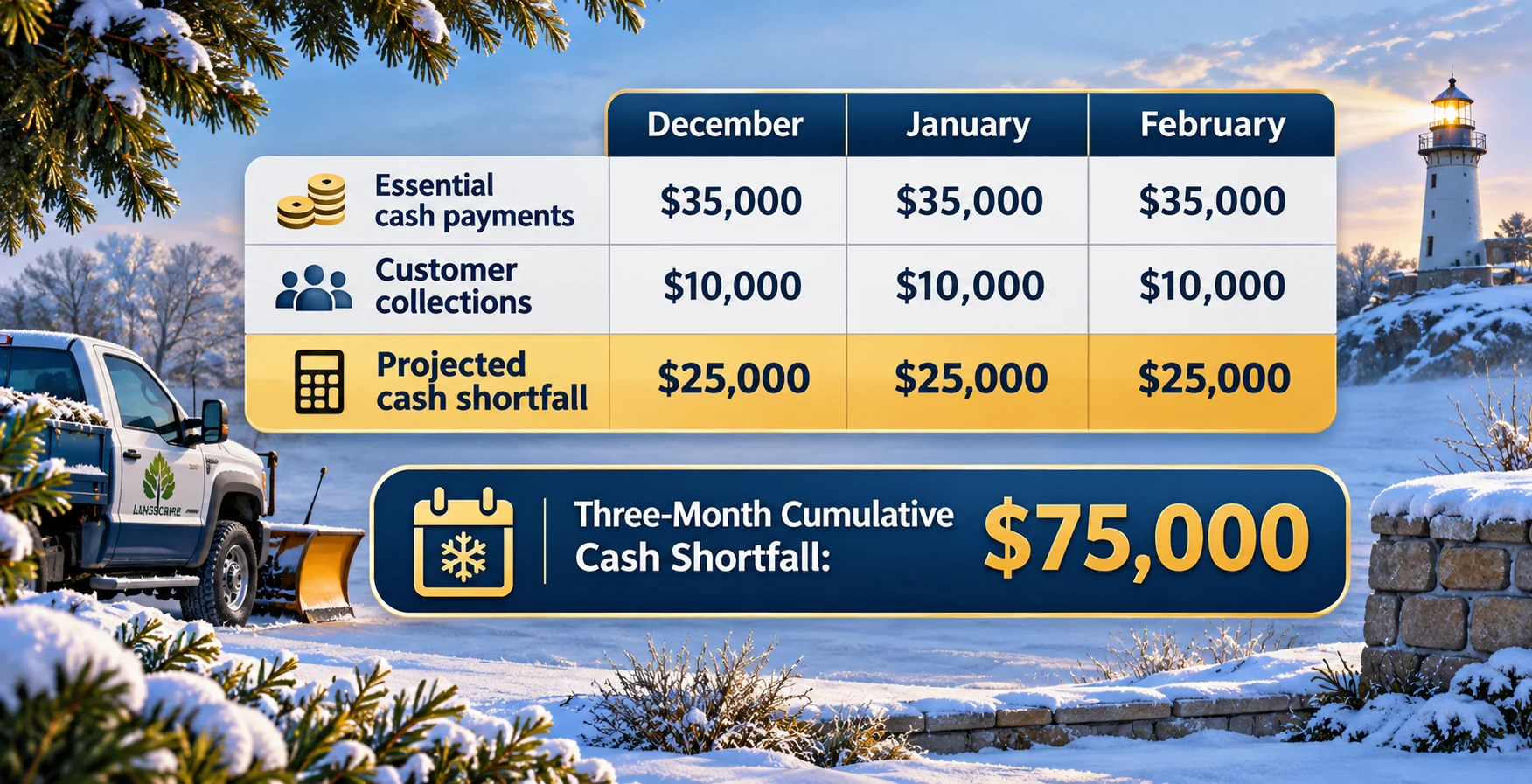
A landscape company expecting $35,000 in essential monthly payments and $10,000 in monthly collections for December through February faces a $25,000 monthly gap, or $75,000 in total. It must fund that predictable gap before winter. A seasonal funding requirement may overlap with an existing reserve target; do not add the same exposure twice. Separate predictable seasonal cash needs from unexpected disruptions.

Credit Helps, but Is Not Cash
A committed line of credit established while the business is healthy can supplement liquidity. It does not count as cash reserves: borrowing costs money, creates repayment obligations and may be limited by lender terms.
Where Should Reserves Live?
A separate, readily accessible, low-risk business deposit account can improve discipline. Prioritize liquidity, safety and access over speculative returns. Consider applicable deposit insurance limits when balances are large.
Test It With a 13-Week Forecast
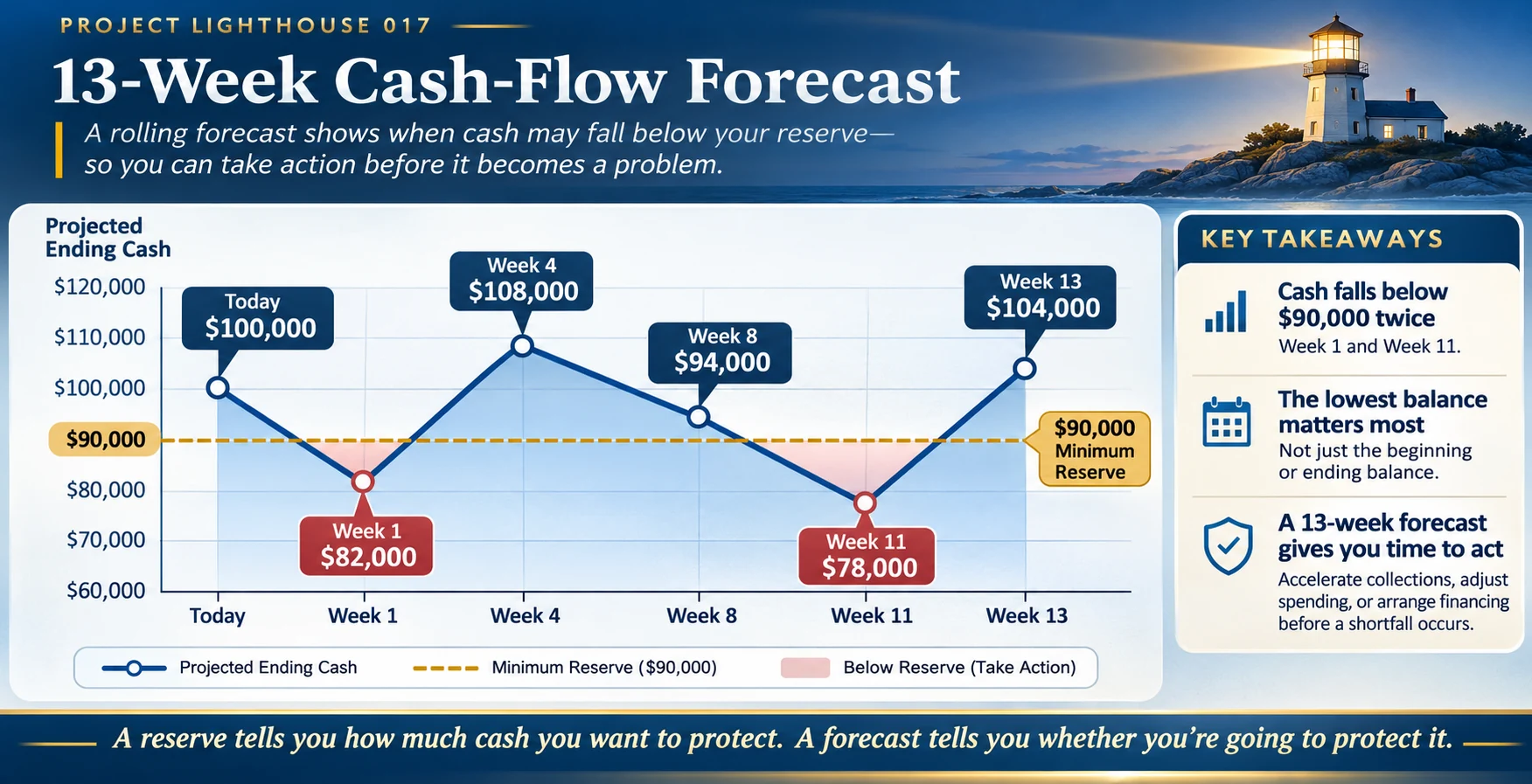
Starting at $100,000, illustrative projected cash is $82,000 in Week 1, $108,000 in Week 4, $94,000 in Week 8, $78,000 in Week 11 and $104,000 in Week 13. The business crosses below its $90,000 floor twice, even though its ending balance looks healthy. A rolling forecast identifies the lowest balance and gives management time to accelerate collections, defer discretionary purchases or arrange suitable financing.
Put your numbers to work: Use our 13-week cash-flow forecasting lesson and Business Financial Health Assessment.
From the CFO’s Desk
Cash reserves are not idle money. They protect payroll, suppliers and management flexibility. Too much idle cash has an opportunity cost, but too little can force expensive decisions at the worst possible time. A reserve tells you how much cash you want to protect. A forecast tells you whether you are going to protect it.
Put It Into Practice
Calculate essential monthly cash obligations; account for debt principal, taxes, planned distributions and seasonal patterns; choose a minimum and a target; fund the gap deliberately; and review the lowest projected balance in a rolling 13-week cash forecast.
The Bottom Line
A $100,000 bank balance can conceal a small business cash reserve shortfall. Our example’s known payments reduce near-term projected cash to $82,000 against a $90,000 minimum before any equipment purchase. The point is not to hoard cash—it is to know how much you need to protect and what you can safely use.
The Lighthouse Principle: Your cash reserve isn’t measured by how much money you have. It’s measured by how long your business can operate when money stops coming in.