
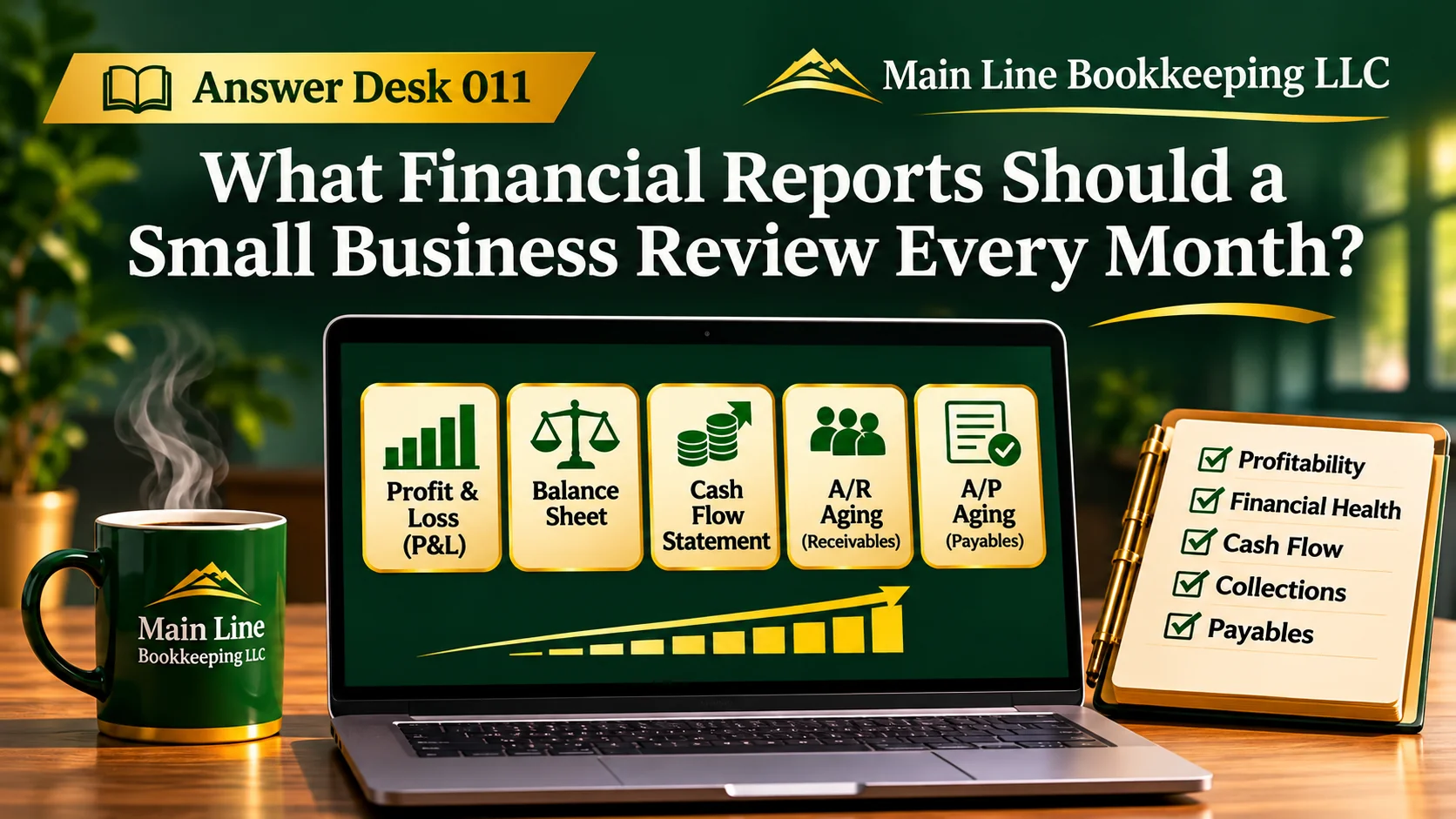
What Financial Reports Should a Small Business Review Every Month?
Quick Answer: The five essential monthly financial reports for small business owners are: the Profit & Loss Statement, Balance Sheet, Statement of Cash Flows, Accounts Receivable Aging, and Accounts Payable Aging. Together, they reveal profitability, financial position, cash movement, customer collections, and upcoming vendor obligations.
Your bank accounts are reconciled. Your transactions are categorized. Your bookkeeper sends over the monthly reports.
Everything looks good.
But here’s a question worth asking:
What are those reports actually telling you about your business?
Too often, financial reporting begins and ends with a glance at the Profit & Loss statement. Revenue looks good, the bottom line is positive, and it’s back to running the business.
But those reports can reveal developing problems, missed opportunities, and financial risks long before they become emergencies.
You don’t need to become an accountant to use them. You just need to know what to look for. Reviewing monthly financial reports for small business performance helps you spot changes before they become costly surprises.
1. Profit & Loss Statement: Are You Actually Making Money?
Your Profit & Loss statement (P&L) shows revenue, expenses, and profitability over a period of time.
But a P&L without comparisons only tells part of the story.
Ask your bookkeeper for three views:
- Current month compared with the same month last year.
- Year-to-date compared with the same period last year.
- Revenue and expense categories expressed as percentages of revenue.
In QuickBooks, comparison columns and percentage-of-income options can make these trends easier to spot. For additional context, see the U.S. Small Business Administration’s guide to managing business finances.
Example: Revenue increased 15%, but gross profit margin fell from 45% to 38%.
You’re selling more, but keeping less of every dollar.
That could indicate higher labor costs, material increases, pricing problems, or a change in your mix of work.
Monthly metric: Gross Profit Margin
Gross Profit Margin = Gross Profit ÷ Revenue × 100
The question: Are we becoming more profitable, or simply busier?
2. Balance Sheet: How Financially Healthy Is Your Business?
Your P&L tells you what happened over time. Your Balance Sheet shows where the business stands on a particular date.
It summarizes assets, liabilities, and equity.
A business can report healthy profits while carrying substantial debt, overdue receivables, or insufficient working capital.
Monthly metric: Current Ratio
Current Ratio = Current Assets ÷ Current Liabilities
A ratio below 1.0 may indicate potential short-term liquidity pressure, although the appropriate ratio depends on the business and its circumstances.
Five Warning Signs Your Books May Need Attention
Your Balance Sheet can also reveal bookkeeping problems.
Watch for:
- Uncategorized, Ask My Accountant, or Suspense balances. These may represent transactions awaiting review or proper classification.
- Growing Undeposited Funds. Amounts that accumulate without explanation may indicate payments that haven’t been properly matched to deposits.
- Unexpected negative balances. Certain negative balances are legitimate, but unexplained amounts deserve investigation.
- Loan balances that don’t agree with lender statements. These may indicate missing transactions, incorrect principal allocations, or reconciliation problems.
- Unexplained payroll liabilities. Taxes and deductions may legitimately remain payable at month-end, but overdue or incorrect balances require attention.
These aren’t automatic proof of errors. They’re reasons to ask questions. The IRS recordkeeping guidance also explains why complete business records matter.
If several appear consistently, it may be time to review your bookkeeping procedures or consider a QuickBooks cleanup.
The question: Is our financial position getting stronger, and can we trust the numbers?
3. Statement of Cash Flows: Where Did the Money Go?
Your P&L shows a $30,000 profit.
But your bank balance barely moved.
Where did the money go?
Profit and cash flow aren’t the same thing.
Under accrual accounting, revenue may be recorded before customers pay. Cash may also be used to purchase equipment, repay loan principal, or make owner distributions without reducing accounting profit by the same amount.
The Statement of Cash Flows explains historical cash movements through operating, investing, and financing activities.
Monthly metric: Net Cash from Operating Activities
This shows whether normal business operations generated or consumed cash during the period.
A profitable business with consistently negative operating cash flow deserves closer attention.
And remember: a cash-flow statement looks backward. A cash-flow forecast looks forward.
For planning upcoming cash needs, our Project Lighthouse series explores the value of a 13-week cash-flow forecast.
The question: Is the business generating enough cash to support its operations and future commitments?
4. Accounts Receivable Aging: Who Owes You Money?
Revenue is great.
Collected revenue is better.
Your Accounts Receivable (A/R) Aging report shows outstanding customer invoices, generally grouped by how long they’ve been unpaid.
Review overdue balances, slow-paying customers, and changes in collection patterns.
Monthly metric: Days Sales Outstanding (DSO)
DSO estimates how long it takes to collect credit sales.
For a simple monthly approximation:
DSO = Average Accounts Receivable ÷ Credit Sales × Days in Period
If your DSO increases from 38 to 52 days, collections are taking approximately two weeks longer.
That can put pressure on cash even when sales are increasing.
DSO isn’t necessarily displayed on the aging report itself; it’s calculated using receivables and credit sales.
Cash versus accrual note: Under cash-basis reporting, unpaid invoices generally aren’t included in P&L revenue. Your A/R Aging report can still show those outstanding invoices if they’re recorded in your accounting system.
The question: Are we collecting what we’ve earned quickly enough?
5. Accounts Payable Aging: What Do We Owe, and When?
Accounts Payable (A/P) Aging shows outstanding vendor bills and how long they’ve remained unpaid.
A healthy bank balance can be misleading when significant obligations are approaching.
Example: You have $75,000 in the bank.
But $55,000 in vendor bills are coming due, plus $30,000 in payroll before your next substantial customer collections.
That’s $85,000 in upcoming obligations against $75,000 in available cash.
Payroll generally doesn’t appear on the A/P Aging report, so it needs to be considered separately in your cash planning.
Monthly metric: Percentage of A/P Past Due
Past-Due A/P % = Past-Due Vendor Balances ÷ Total A/P × 100
An increasing percentage may signal cash pressure, payment-processing problems, or disputes requiring attention.
The question: Can we meet our obligations without creating unnecessary financial pressure?
One More Report for Project-Based Businesses
If you’re a contractor, landscape designer, or another project-based business, add a Job Profitability Report to your monthly review.
It helps identify which projects are making money and which are consuming more labor, materials, or subcontractor costs than expected.
For longer-term projects, a Work in Progress (WIP) schedule may also be necessary to evaluate project status, earned revenue, costs to complete, and profitability.
Company-wide profit doesn’t tell you which jobs are driving the results.
Five Questions for Your Monthly Financial Review
You don’t need to spend hours studying financial statements.
Start with five questions:
- Are we more profitable? Compare revenue, gross margin, and operating expenses against prior periods.
- What changed, and why? Identify the two or three most significant differences.
- Are customers paying on time? Review overdue invoices and collection trends.
- Do we have enough cash? Consider vendor payments, payroll, taxes, debt, and upcoming purchases.
- What needs to happen next? Identify specific actions, responsible people, and deadlines.
That last question matters most.
If your financial review ends with "Interesting numbers," you’ve only done half the job.
When Should You Receive Your Monthly Reports?
For many small businesses, receiving completed financial reports within 10–15 calendar days after month-end is a reasonable target.
That assumes the necessary bank statements, payroll information, invoices, and other records are available promptly.
More complex businesses may need additional time.
The important thing is establishing a consistent closing schedule so your reports are accurate, timely, and useful.
Cash balances, receivables, and upcoming payments may require weekly attention, particularly when cash is tight.
Accurate Bookkeeping Is the Starting Point, Not the Finish Line
Bookkeeping records and organizes financial activity.
Financial reporting makes that information visible.
Financial analysis helps explain what changed, why it changed, and what you should consider doing next.
A P&L might show declining gross margins.
A deeper review can help determine whether the problem is pricing, labor efficiency, rising costs, or the types of jobs you’re taking.
But before making those decisions, you need confidence that the underlying numbers are accurate.
Good financial decisions require both reliable bookkeeping and meaningful analysis.
At Main Line Bookkeeping, that’s the foundation of our approach: helping business owners understand what their numbers are really telling them.
Are Your Financial Reports Telling You Enough?
If you’re receiving monthly reports but still struggling to understand profitability, cash flow, or financial performance, it may be time to take a closer look.
Start with our Business Financial Health Assessment to identify potential gaps in your bookkeeping, reporting, and financial visibility.
You can also explore our Monthly Bookkeeping Cost Guide to better understand what professional bookkeeping services typically include.
The bottom line:
Your financial reports shouldn’t simply tell you what happened last month.
They should help you understand what’s happening in your business—and what to do next.
Main Line Bookkeeping LLC — CFO-level bookkeeping. Main Line & Beyond.



One Comment
Comments are closed.