13-Week Cash Flow Forecast for Small Business | Main Line Bookkeeping


Project Lighthouse · Lesson 007
Your Bank Balance Looks Fine. But What Happens Seven Weeks From Now?
How a simple 13-week cash-flow forecast can help you spot problems, protect opportunities, and make better decisions before cash gets tight.
Executive Brief
A healthy bank balance today does not necessarily mean there will be enough cash for what comes next.
Payroll, taxes, loan payments, vendor bills, equipment purchases, and other obligations do not always arrive at the same time as customer payments.
A business can be profitable, growing, and doing just fine—and still get squeezed for cash simply because of timing.
In this edition of Project Lighthouse, we’ll look at a simple way to see potential cash pressure weeks before it reaches your bank account—and how a 13-week cash flow forecast can give you something every business owner could use more of:
Time to make a decision.
Key Takeaways
- Today’s bank balance does not show tomorrow’s obligations.
- Cash-flow pressure is often about timing, not profitability.
- A 13-week cash-flow forecast can help you see pressure before it arrives.
- Do not just watch the ending balance—identify your projected cash low point.
- Visibility creates time. Time creates choices. Choices create control.
$72,418 Looks Pretty Good
It is Monday morning.
You open the bank account and see $72,418.
Payroll is covered. The bills are current. Sales have been good.
Accounts receivable shows another $94,000 due from customers.
You look at the numbers and think:
“We’re in pretty good shape.”
And today, you may be right.
But there is another question worth asking:
For how long?
Over the next several weeks, several payrolls will clear. Quarterly taxes are due. Insurance has to be paid. Large vendor invoices are coming. And you have already committed to a $15,000 equipment deposit.
Most of that $94,000 in receivables is expected later.
Nothing has to go wrong.
The calendar simply has other plans for your cash.

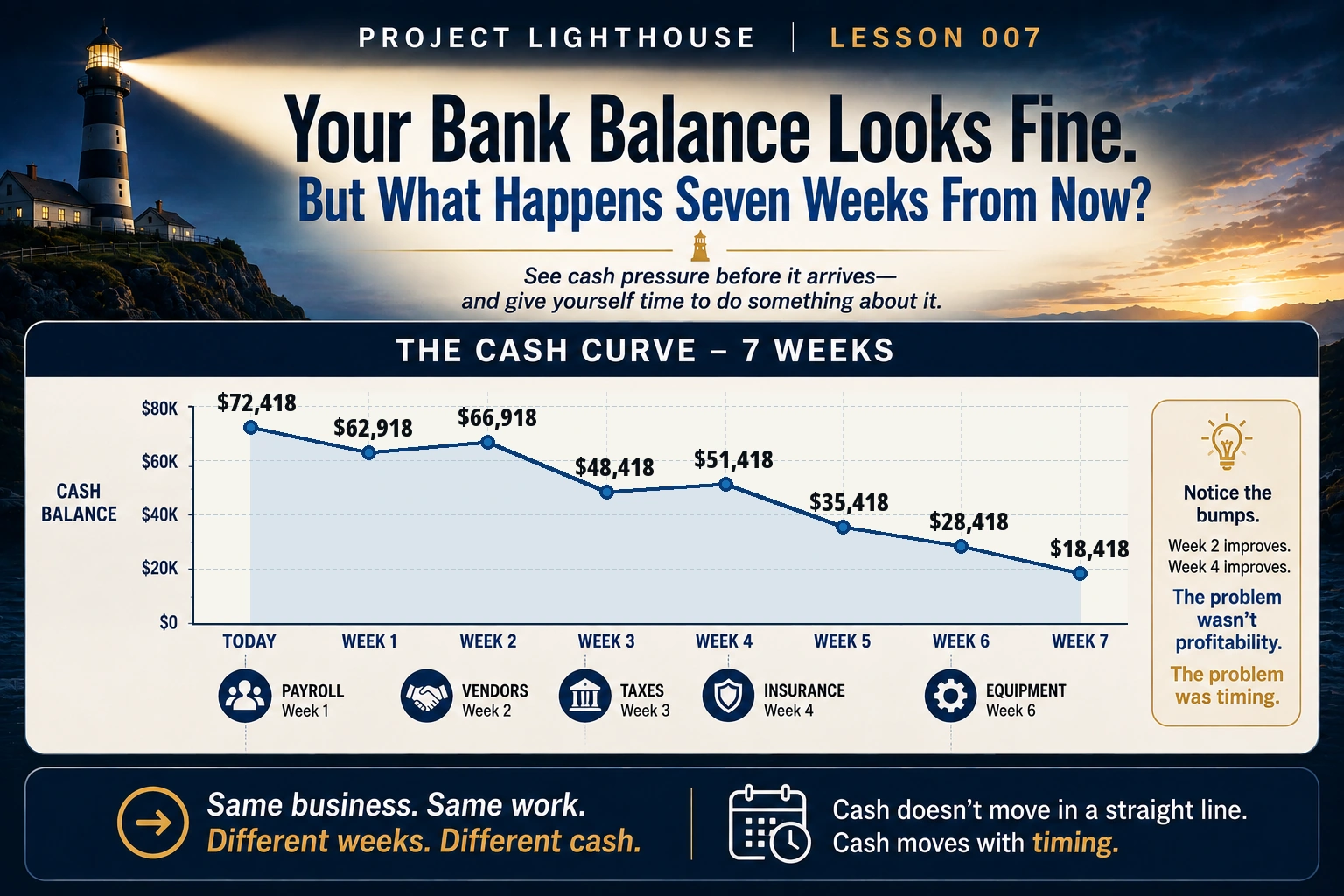
By Week 7, that comfortable $72,418 has become $18,418.
Managing by bank balance is understandable. The number is real, current, and easy to see.
But your bank balance tells you what cash is available today. It doesn’t tell you what that cash may need to cover tomorrow.
And this is where we start moving beyond bookkeeping and into financial management.
Instead of asking only, “What happened?” we also begin asking:
“Based on what we know today, what is likely to happen next?”
The goal of forecasting is not to predict the future perfectly. It is to see far enough ahead that you still have choices.
Maybe you accelerate a collection. Move a purchase. Talk to a vendor. Adjust an owner distribution. Arrange financing before you desperately need it.
It gives you time to prepare for what the future might be.
The Calendar Has Other Plans for Your Cash
The problem with looking at today’s bank balance isn’t that the number is wrong. It’s that the number is incomplete.
Some of that cash will cover payroll and vendors. Some will cover taxes, insurance, loan payments, or equipment you’ve already committed to.
And the $94,000 sitting in Accounts Receivable is not cash yet.
Put the known timing on a calendar and the story becomes easier to see:
| Week | Beginning Cash | Expected In | Expected Out | Ending Cash |
|---|---|---|---|---|
| 1 | $72,418 | $18,000 | $27,500 | $62,918 |
| 2 | $62,918 | $24,000 | $20,000 | $66,918 |
| 3 | $66,918 | $11,000 | $29,500 | $48,418 |
| 4 | $48,418 | $21,000 | $18,000 | $51,418 |
| 5 | $51,418 | $9,000 | $25,000 | $35,418 |
| 6 | $35,418 | $16,000 | $23,000 | $28,418 |
| 7 | $28,418 | $12,000 | $22,000 | $18,418 |
Cash does not fall in a straight line. Week 2 actually improves. Week 4 improves again.
If you happened to check the bank account during either week, you might conclude everything was moving in the right direction.
The forecast tells a different story.
Cash simply came in later than cash needed to go out.
On that first Monday morning, Week 7 already existed. You just couldn’t see it by looking at the bank account.
The Number We’re Really Looking For
Week 7 ends at $18,418.
But that’s not the number I’m most interested in.
What matters is what that number means for the business.
Is $18,418 enough to operate comfortably? What if a $25,000 customer payment arrives two weeks late? What if a truck suddenly needs a $7,500 repair? What if sales soften? What if an unexpected opportunity requires $10,000?
This is why one of the most useful numbers in a cash-flow forecast is the projected cash low point.
Once we can see it, we can ask whether the business still has enough breathing room.
Now we’re not worrying. We’re planning. And there’s a huge difference between the two.
How a 13-Week Cash Flow Forecast Works
A 13-week cash-flow forecast is simply a rolling estimate of the cash you expect to receive and the cash you expect to pay over roughly the next three months.
The basic math is not complicated:
Beginning Cash + Expected Cash In − Expected Cash Out = Projected Ending Cash
Carry that ending balance into the next week and repeat.
No mystical CFO formula. No 47-tab spreadsheet. No requirement that you predict the future with supernatural accuracy.
You’re simply putting time alongside the money.
Thirteen weeks is far enough ahead to spot potential pressure, but close enough that many of the important cash events are already visible or reasonably estimated.
START WITH: Cash available today.
ADD: Customer payments and other expected receipts.
SUBTRACT: Payroll, vendors, rent, taxes, debt payments, insurance, equipment, owner distributions, and other known cash needs.
RESULT: Projected ending cash.
REPEAT: Carry the ending balance into the next week.
Now That You Can See Week 7, What Can You Do About It?
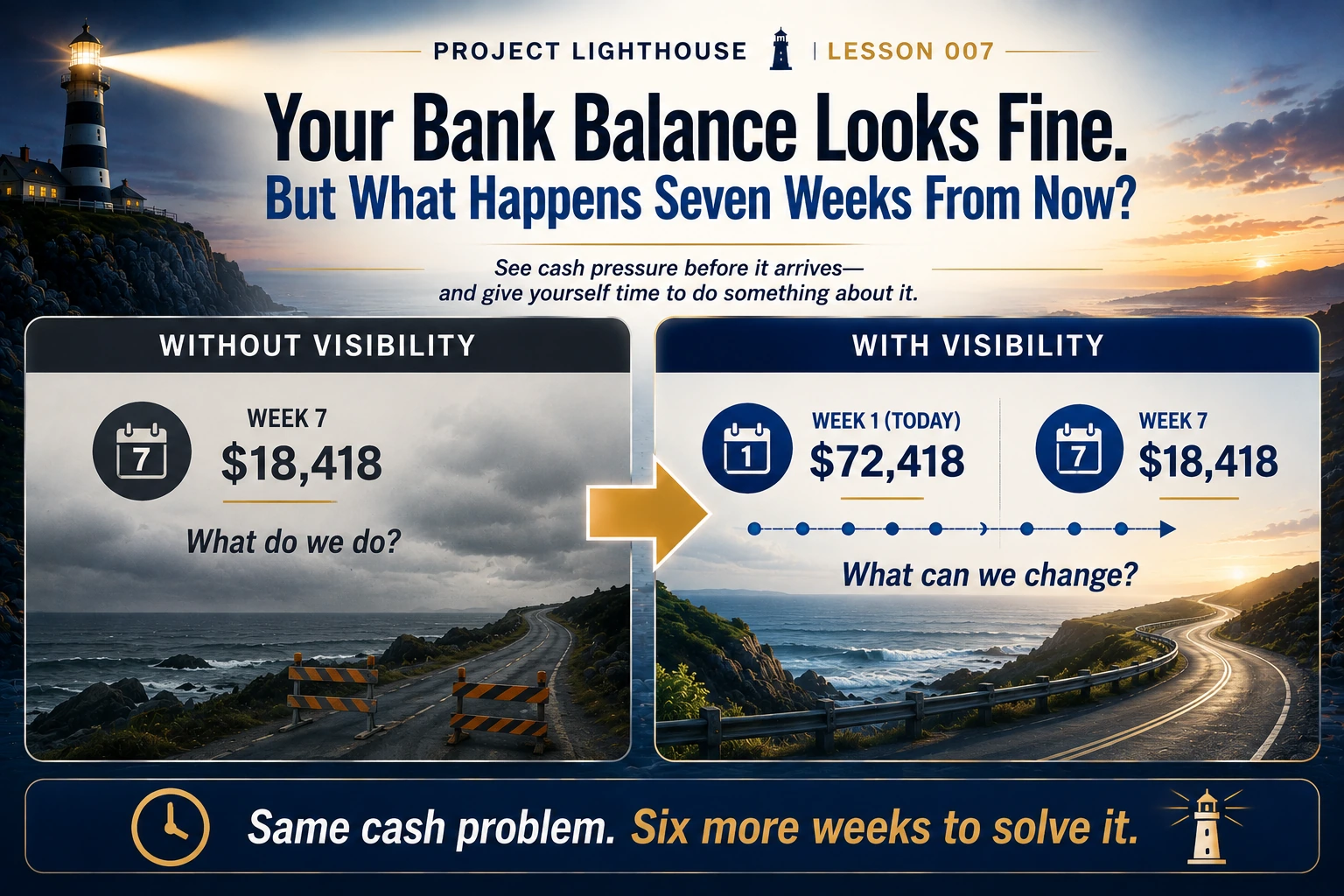
The value of seeing $18,418 is not the number itself.
The value is seeing it six weeks before you get there.
Now there is time to ask better questions.
Could we accelerate a collection?
Could the $15,000 equipment deposit move to Week 9?
Could a large vendor payment be split between weeks?
Should we reconsider an owner distribution?
If working capital may be needed, would we rather arrange it while the business looks healthy—or call the bank on Thursday because payroll is Friday?
Sometimes the forecast tells you, “You’re fine.” That is valuable too.
A cash forecast isn’t designed to find bad news. It’s designed to replace guessing with visibility.
A Forecast Isn’t a Promise
A common objection to cash forecasting is simple:
“But I don’t know exactly when my customers are going to pay.”
Of course you don’t.
And the forecast won’t always turn out exactly as expected. That’s why we update it.
Use reasonable assumptions. Put known expenses where they belong. Do not build the survival of the business around revenue that has not been earned or confirmed.
When a customer payment moves, move it. When a new expense appears, add it. When something changes, update the forecast.
The objective isn’t perfect precision. The objective is preparedness.
The forecast should move because your business moves.
Be Conservative Where It Matters
Forecasting requires assumptions. When there’s uncertainty, don’t automatically choose the assumption that makes the numbers work.
If a customer might pay in Week 4 but historically pays closer to Week 6, plan for Week 6.
If a $30,000 sale is still a proposal, do not spend that money in the forecast.
If an expense is likely to land somewhere between $8,000 and $10,000, planning closer to $10,000 may give you the more useful picture.
The purpose of the forecast isn’t to prove everything will be okay. It’s to give us more time to do something when it may not be.
A forecast isn’t a promise. It’s a planning tool.
The 15-Minute Weekly Cash Habit
The real value comes from making the forecast a rolling habit.
Each week, one week falls off and another week gets added. Think of it as moving the headlights forward.
Spend about 15 focused minutes asking:
- What actually came in?
- What didn’t come in?
- What actually went out?
- What changed?
- Where is our new cash low point?
Move delayed customer payments to when you now expect them to arrive. Update expenses. Add anything new. Then look down the road again.
Fifteen focused minutes once a week can materially improve your visibility.

From Cash Anxiety to Cash Strategy
Once you begin looking ahead, the questions start to change.
You stop treating cash as something that simply happens to the business.
Cash can be planned. Managed. Anticipated.
Visibility Creates Time.
Time Creates Choices.
Choices Create Control.
Cash problems are hardest to solve when they become today’s problem. They’re much easier to solve when you can see them weeks ahead.
Put It Into Practice: Your Monday-Morning Cash Check
Start with the cash available today.
Add the collections you reasonably expect to receive.
Subtract the payments you reasonably expect to make.
Find the projected cash low point.
Then stress-test it.
Then ask the question that makes the forecast worth doing: What can we change while we still have time?
- ✓ Update cash actually received.
- ✓ Move customer payments that didn’t arrive.
- ✓ Update actual and newly known expenditures.
- ✓ Add another week to the forecast.
- ✓ Identify the lowest projected cash balance.
- ✓ Ask whether the business has enough cushion.
- ✓ Make decisions before the forecast makes them for you.
You don’t need to know exactly what’s coming. You need enough visibility to prepare for what might be.
The Bottom Line
Your bank balance matters. But it’s today’s answer.
A 13-week cash-flow forecast won’t tell you exactly what will happen over the next three months. It doesn’t need to.
Its job is to help you see what may happen soon enough that you still have choices.
That’s when cash stops being something you react to and becomes something you manage.
Good financial reporting helps you understand where you’ve been.
Good financial management helps you prepare for where you’re going.
Continue the Project Lighthouse Conversation
If you’d like a deeper explanation of why a profitable business can still feel cash-starved, see Project Lighthouse Lesson 003: Your Business Is Profitable. So Why Is There No Cash?
In Lesson 006, we explored how financial information can help you evaluate an important decision before making it.
The sooner your numbers help you see what’s ahead, the more choices you may have about what to do next.
What Does Your Financial Picture Say About What’s Ahead?
The Business Financial Health Assessment is designed to help you step back, look at that larger picture, and identify where greater financial clarity may lead to better decisions.
Because sometimes the most valuable thing your numbers can give you isn’t an answer.
It’s an early warning.
Start Your Complimentary Business Financial Health Assessment
Next Week in Project Lighthouse
How Much Cash Should Your Business Keep in Reserve?
You’ve probably heard rules of thumb such as “keep three months of expenses in cash.” But the right reserve for one business may be completely wrong for another.
Payment patterns, seasonality, debt, fixed expenses, access to credit, and the natural ups and downs of the business all affect how much breathing room makes sense.
Next time, we’ll start answering a more useful question:
How much financial breathing room does our business need?