We’re Busy—So Why Aren’t We Making More Money?


Executive Brief
The phones are ringing. Your crews are busy. Revenue is climbing. So why does it still feel like you are working harder without making more money?
More sales do not automatically create more profit. They create more opportunity—but only when each sale leaves enough behind after the work is delivered.
Those remaining dollars are your Gross Profit. Express Gross Profit as a percentage of revenue, and you have your Gross Margin. Gross Profit shows how many dollars the work produced; Gross Margin shows how efficiently each sales dollar produced them.
Those Gross Profit dollars are what remain available to pay overhead, support growth, reward the owner, and create lasting financial strength.
In this edition of Project Lighthouse, we will explore why revenue can rise while profit stays flat, where margin quietly disappears, and the four questions every business owner should ask each month.
One of the biggest surprises for business owners is discovering that a record revenue month can still produce disappointing profits.
When I review financial statements with clients, I rarely start by asking, “How much did you sell?”
I start by asking, “How much did you keep after delivering the work?”
That answer often explains everything that follows.
The Growth Trap: When More Work Does Not Mean More Profit
For many business owners, growth feels like the ultimate goal.
More customers. More jobs. More invoices. More revenue.
After all, if sales are increasing, profits should naturally follow… right?
Unfortunately, that is not always how it works.
Many companies eventually reach what I call the Growth Trap—a point where the business becomes busier than ever while the owner’s financial reward barely changes.
Your team is working overtime. The schedule is booked weeks in advance. You may have hired more people or purchased more equipment just to keep up.
From the outside, it looks like success.
Behind the scenes, the checking account never seems to grow as expected. Cash flow still feels tight. Taking more money home feels just as difficult as before.
The natural reaction is to sell more. But adding work to a business that is not keeping enough from each sale often creates only one thing:
More stress without more success.
Growth without margin is like running faster on a treadmill—you expend more energy without actually getting farther ahead.
Revenue Is Only the Starting Line
Revenue is one of the easiest numbers in business to celebrate.
It appears on sales reports, dashboards, newsletters, and social media posts. It is the number everyone likes to announce.
But here is the question that rarely gets asked:
How much of that revenue actually belonged to the business?
Every sales dollar immediately begins heading back out again. Materials must be purchased. Employees and subcontractors must be paid. Fuel, freight, equipment, supplies, and other direct job costs all claim their share.
Only after those costs are paid does the business discover how much of each sales dollar it actually earned.
That remaining dollar amount is Gross Profit.
A quick distinction: Gross Profit is the dollar amount left after direct costs. Gross Margin is that same Gross Profit expressed as a percentage of revenue.
For example, if $100,000 of revenue produces $35,000 of Gross Profit, the business earned a 35% Gross Margin.
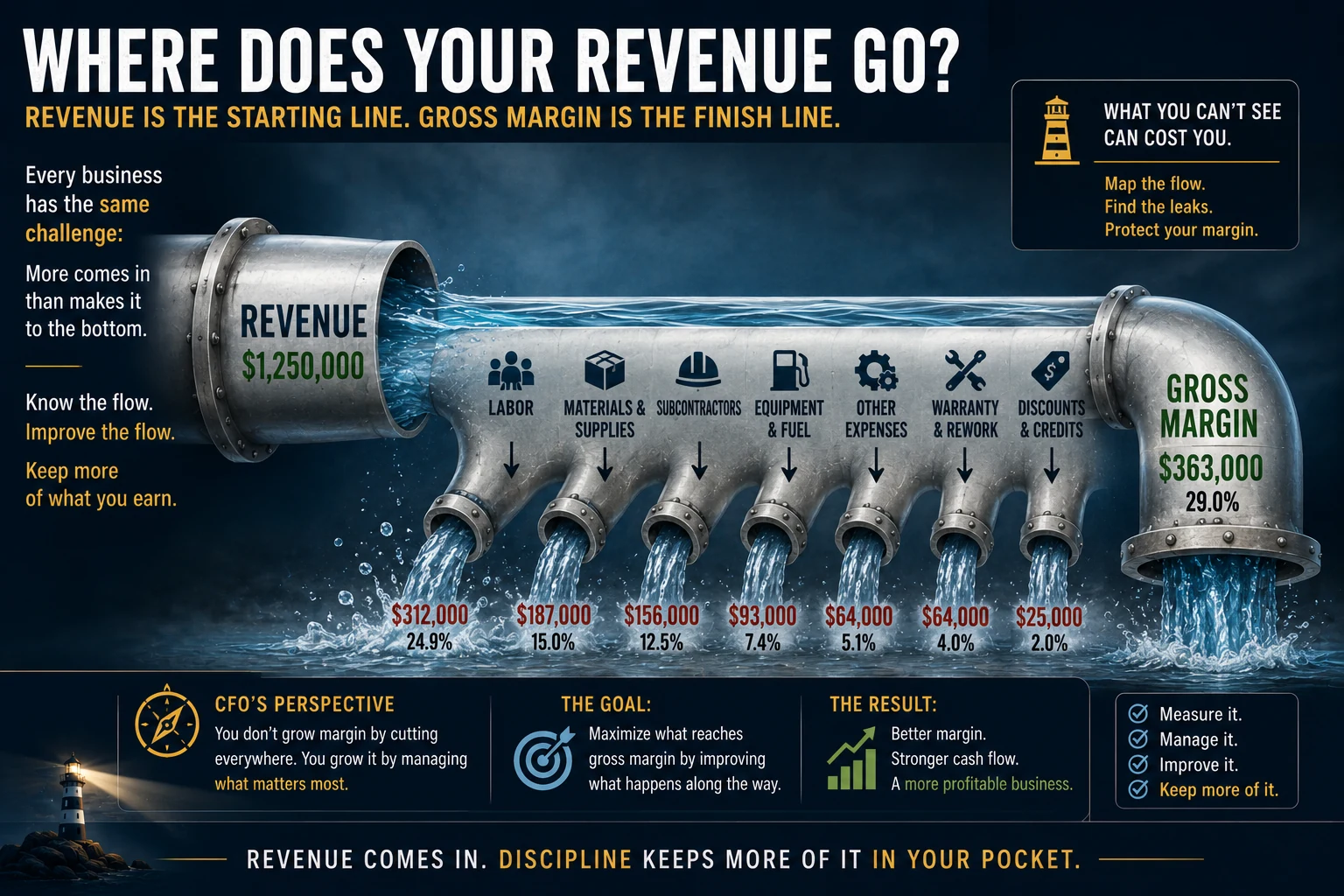
Gross Profit is not just another accounting calculation. It is the financial capacity your business creates from the work it performs.
Those dollars help pay for office staff, rent, insurance, marketing, software, vehicles, owner compensation, and ultimately Net Profit.
Revenue gets all the applause. Gross Profit quietly pays the bills. Gross Margin tells you how efficiently you earned it.
That is why two companies with identical revenue can have completely different financial futures.
One has built a stronger business. The other has simply built a larger workload.
The Silent Margin Killers
Gross Profit rarely disappears all at once.
It leaks away.
A little here. A little there.
One discounted proposal. One project that took two days longer than expected. A warranty callback nobody planned for. A crew waiting because materials did not arrive on time.
Individually, none of these events may look large enough to threaten the business. Collectively, they can quietly erase thousands of dollars over a year.
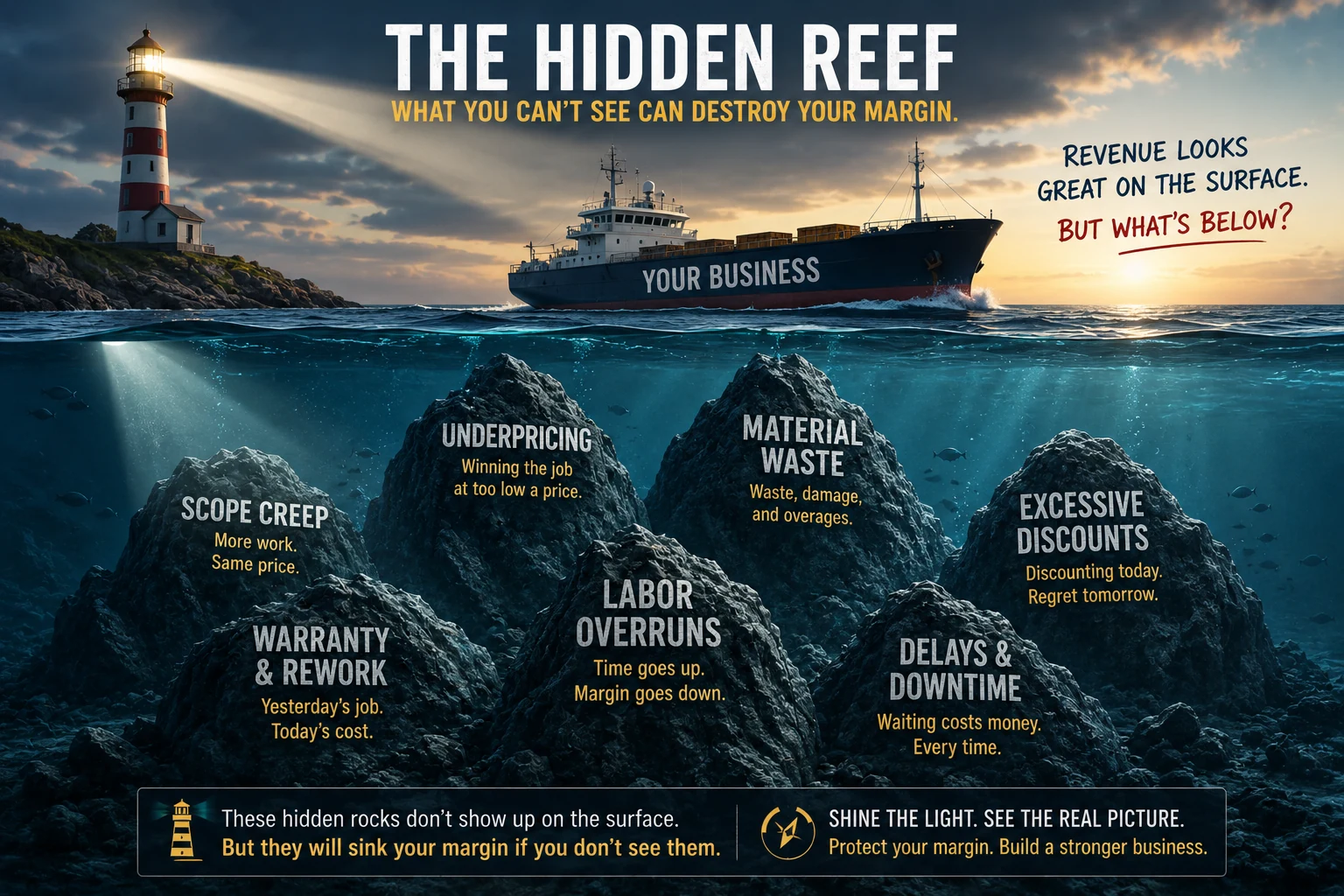
Common margin killers include underpricing, labor overruns, material waste, scope creep, warranty work, rework, excessive discounting, and idle time caused by scheduling or material delays.
Notice something important?
None of those problems begins in the accounting department.
Accounting reports the result. Operations create it.
Improving Gross Profit and Gross Margin is not about finding a different report. It is about making better pricing, estimating, scheduling, purchasing, and project-management decisions throughout the month.
You Cannot Fix a Leak by Pouring in More
Imagine spending your day filling a five-gallon bucket with water.
The hose is running full blast, but several small holes have been drilled into the bottom.
Your first instinct might be to turn the water on even faster.
That does not solve the problem. It simply wastes more water.

Businesses often react the same way when profits disappoint: they chase more sales.
Sometimes the better answer is not creating more revenue.
It is protecting more of the revenue you have already earned.
Your financial statements should not merely tell you what happened last month. They should help you make better decisions next month.
If revenue increased but Gross Margin declined, understand why before celebrating the sales growth.
Pursue more of the work that is well-priced, efficiently managed, and completed without costly surprises.
Look for patterns in estimating, labor hours, material waste, rework, warranty claims, delays, and discounting.
Growth should create opportunity, stability, profit, and freedom—not only longer hours and greater stress.

Put It Into Practice
The businesses that consistently improve are not necessarily run by owners who know the most accounting.
They are run by owners who become curious about what is driving the results.
Revenue tells you how much work you sold.
Gross Profit tells you how many dollars the work produced.
Gross Margin tells you how efficiently you produced them.
Bringing It All Together
Every business owner wants to grow.
More customers. More revenue. More opportunities.
Those are worthy goals.
But healthy businesses are not built simply by doing more work. They are built by keeping enough from the work they already do.
The next time your business has a record sales month, celebrate it. You have earned that moment.
Then ask one more question:
“How much of those sales actually strengthened our business?”
The answer may tell you more about your future than the revenue number ever could.
Revenue measures how much business came through your doors.
Gross Profit measures how many dollars stayed behind. Gross Margin shows what percentage of every sales dollar remained to help build your future.
Ready to Understand What Your Revenue Is Really Producing?
Your business may not need more reports.
It may need the right numbers, the right questions, and a clearer view of what is strengthening—or quietly weakening—your financial performance.
Our Business Financial Health Assessment helps business owners connect profitability, cash flow, reporting, and operational decisions so they can build a stronger and more rewarding business.
Next Week in Project Lighthouse
Which jobs are making you money… and which ones are quietly costing you?
We will explore why some customers, services, and projects build your business while others consume far more time, labor, and resources than they return.