Should I Hire a Bookkeeper or a CFO for My Growing Business?
Bookkeeper or CFO—which does your growing business need?
If your biggest challenge is keeping accurate books, reconciling accounts, and producing reliable financial reports, you probably need a bookkeeper. If your books are already reliable but you need help with cash flow, profitability, forecasting, hiring, pricing, or other financial decisions, you may be ready for CFO-level help.
For many growing businesses, though, the answer isn’t necessarily one or the other. Good bookkeeping creates the financial foundation. CFO advisory uses that information to help you decide what to do next.
Bookkeeper or CFO: What’s the Difference?
The easiest way to think about the difference is this:
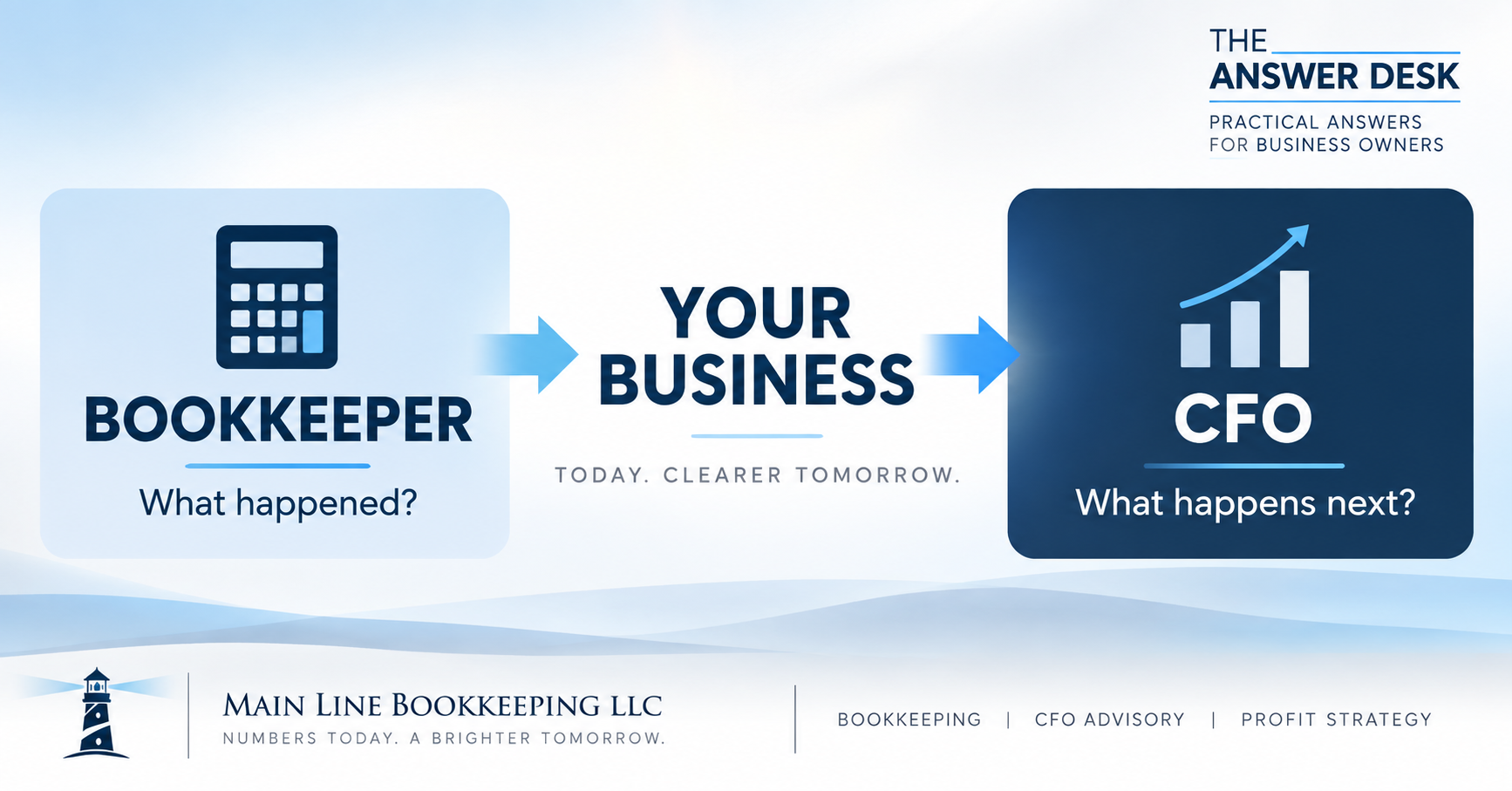
Bookkeeping tells you what happened.
CFO advisory helps you decide what happens next.
You Probably Need a Bookkeeper If…
- Your books aren’t consistently up to date.
- Bank and credit card accounts aren’t being reconciled regularly.
- You’re spending too much time entering or fixing transactions.
- You aren’t confident your financial reports are accurate.
- Tax time turns into a scramble to clean everything up.
- You need reliable monthly financial statements.
You May Need CFO-Level Help If…
- Your books are accurate, but you’re not sure what the numbers are telling you.
- Cash flow keeps surprising you.
- Revenue is growing, but profit isn’t growing with it.
- You’re considering hiring, equipment, financing, expansion, or another major investment.
- You need forecasts, budgets, KPIs, or better management reporting.
- You want financial input before making important business decisions.
Sometimes You Need Both
A growing business doesn’t always fit neatly into one box. You may need someone keeping the books accurate and current while also needing higher-level financial guidance.
That’s because CFO-level advice is only as useful as the information behind it. If the books aren’t reliable, forecasting, margin analysis, cash-flow planning, and other financial decisions can be built on a shaky foundation.
Think of it as a progression: get the numbers right, understand what they’re telling you, and then use them to make better decisions.
The 60-Second Test: Which Do You Need?
You don’t need a complicated assessment to get a pretty good idea of where your business stands. Ask yourself these three questions.
1. Are your books accurate and current?
If you’re not sure, or the answer is no, start with bookkeeping. Before you can make good financial decisions, you need numbers you can trust.
2. Do you understand what your financial reports are telling you?
If your books are accurate but you’re looking at a Profit & Loss Statement, Balance Sheet, or cash-flow report and wondering what you should actually do with that information, you may benefit from CFO-level advisory help.
3. Are you facing an important financial decision?
Maybe you’re considering another employee, purchasing equipment, changing prices, borrowing money, expanding the business, or trying to figure out why increasing sales aren’t producing increasing profits.
If you find yourself saying, “I wish I knew what these numbers would look like before I make this decision,” you’ve moved into CFO and financial advisory territory.
Still Not Sure Whether You Need a Bookkeeper or CFO?
Reliable financial information is the foundation. Once the numbers are right, it becomes much easier to determine whether you simply need ongoing bookkeeping or whether your business would benefit from CFO-level analysis and guidance.
The goal isn’t to add another financial professional just because your company has reached a certain revenue number. The goal is to have the right level of financial help for the decisions you’re making today.
Want to See What CFO-Level Thinking Looks Like?
Project Lighthouse takes a deeper look at the financial decisions business owners face after the books are accurate.
For example, we look at questions such as:
- How much cash will the business need over the next 13 weeks?
- Will an investment actually produce an acceptable return?
- Can the business afford to hire another employee?
Explore Project Lighthouse to learn how to use your numbers to make better business decisions.
Need Help Figuring Out Where Your Business Stands?
If you’re deciding between a bookkeeper or CFO, start by identifying the problem you’re actually trying to solve. Sometimes the problem is the bookkeeping. Sometimes the books are fine and the real challenge is understanding what the numbers mean for the business.
Main Line Bookkeeping provides monthly bookkeeping and reporting, QuickBooks support, and CFO advisory services designed to help business owners move from accurate numbers to better decisions.